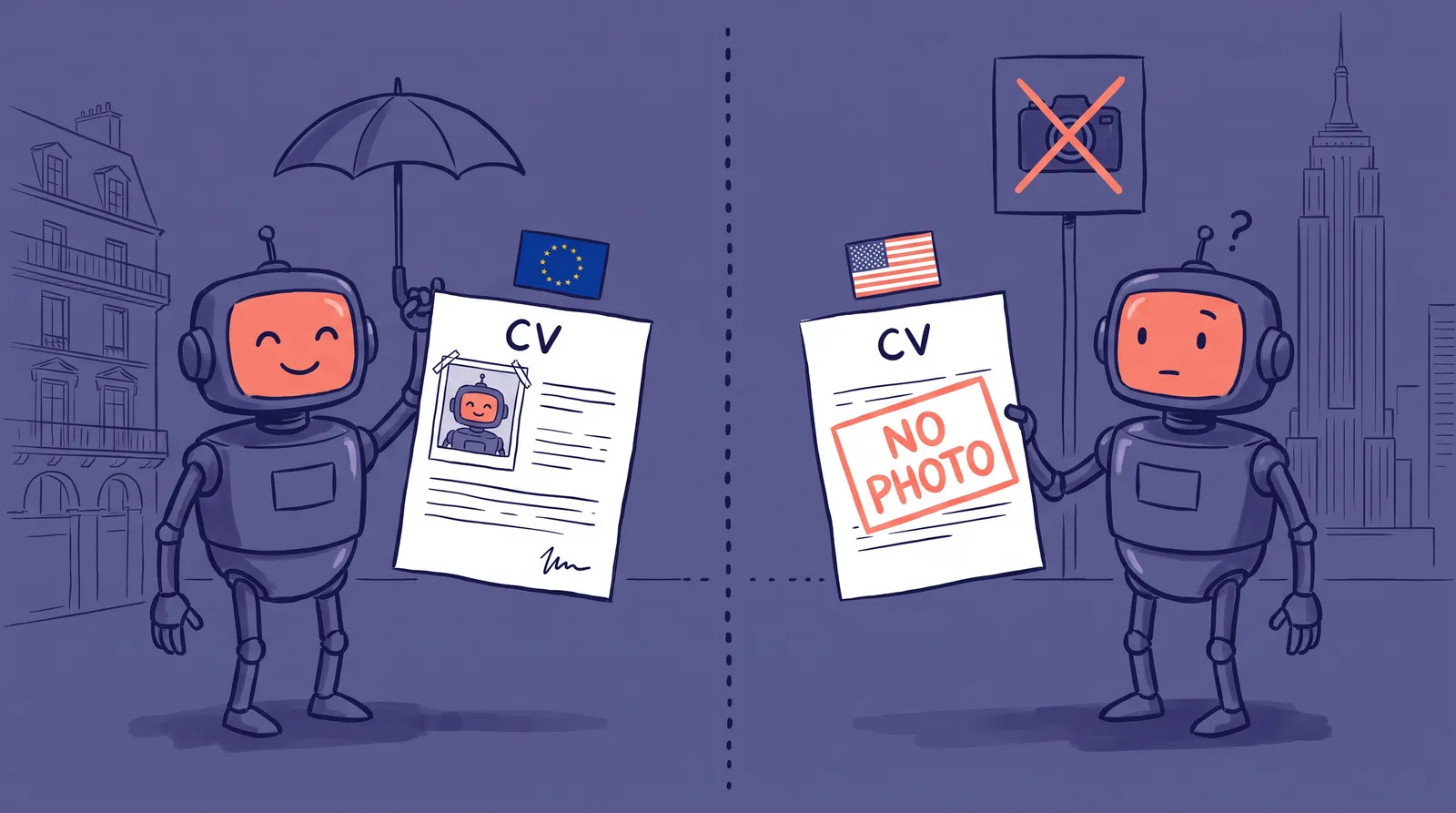
Send the same resume to a hiring manager in Munich and one in Minneapolis, and the paper itself will not survive the trip unchanged. In Germany, a resume without a photo in the top corner reads as unfinished. In the United States, a resume with one can get quietly binned before anyone reads your job history. Same document, same qualifications, two completely different outcomes, and neither hiring manager is doing anything unusual for their country.
That split is not folklore. It comes from two governments reading the same discrimination risk and drawing opposite conclusions about what a photo does to it.
Why US hiring law treats your headshot as evidence
The Equal Employment Opportunity Commission puts it plainly: "employers should not ask for a photograph of an applicant. If needed for identification purposes, a photograph may be obtained after an offer of employment is made and accepted." The agency's broader guidance is that pre-employment questions should stick to what is "essential for determining if a person is qualified for the job," and that anything revealing race, sex, national origin, age, or disability status can be used as evidence of discriminatory intent if a rejected candidate later sues.
A photo does that job better than almost any other single detail on a page. It signals age, race, and often disability status, all before a recruiter has read a single line of your work history. Title VII of the Civil Rights Act, the Age Discrimination in Employment Act, and the Americans with Disabilities Act all give a rejected applicant grounds to argue the photo played a role, and the employer carries the burden of proving it didn't. That is a hard thing to prove about a decision that happened in someone's head in four seconds.
So plenty of large US employers solve the problem before it starts. Applicant tracking systems get configured to flag or strip attached photos, and some HR teams are trained to set a photo-bearing resume aside without reading further, specifically so nobody downstream can be accused of having seen it. You are not being punished for vanity. You are being kept out of a discrimination lawsuit the company doesn't want to have.
The UK reasons the same way
Britain's Equality Act 2010 lists the same kind of protected characteristics: age, disability, race, religion, sex, and several others. A photo reveals several of them at a glance, which is why UK recruitment guidance follows the American logic almost exactly: a CV should demonstrate that a hiring decision was made on merit, and a photo is one more thing a rejected candidate could point to later. The exception both countries carve out is obvious once you say it out loud. Acting and modeling are jobs where appearance is the qualification, so a headshot stays part of the application.

Germany and France have the same worry, and a different answer
Here is the part that trips people up: Germany's anti-discrimination law is not weaker than America's. The Allgemeines Gleichbehandlungsgesetz, Germany's General Equal Treatment Act, has covered hiring since 2006 and protects the same list of characteristics the EEOC does. No German employer is legally entitled to demand a photo. And yet the Bewerbungsfoto, a studio headshot in the top right corner of page one, remains the default on a huge share of German applications. Skip it and some traditional employers and public-sector recruiters will quietly wonder why, the same instinct in reverse of what happens in the US.
France sits in the middle, and its legal history shows how unsettled the question really is. Article L1132-1 of the French Labor Code bans hiring discrimination on a long list of grounds, physical appearance among them. In 2006, French lawmakers went further and passed a law requiring companies with more than 50 employees to review every CV anonymously. It never took effect. The government never issued the implementing decree the law needed, and when the Conseil d'État, France's highest administrative court, finally ordered the Prime Minister in 2014 to publish one, lawmakers moved first: a 2015 law rewrote the rule so anonymous CV review became optional rather than mandatory, and the 2006 mandate was formally repealed. Nine years of a law on the books that never once applied to a single hire.
What actually happens when you strip the photo out
Germany ran the real experiment. Stripping photos and other personal details out of the first round of review measurably improved interview odds for women and for applicants with a migration background, and it is worth walking through in detail because it is the closest thing to hard data this question has.
Between 2010 and 2012, the Antidiskriminierungsstelle des Bundes, Germany's federal anti-discrimination agency, ran a pilot with eight organizations willing to review applications with personal details hidden for the first round: no name, gender, birthdate, marital status, or photo. The participants were a mix of household names and public bodies, including Deutsche Post DHL, Deutsche Telekom, L'Oréal Deutschland, Procter & Gamble, and the German Federal Employment Agency's regional office in North Rhine-Westphalia. Each organization ran the anonymized process for a full year in at least one hiring area.
The scale of it, according to the final evaluation report published by the agency in March 2012: 8,550 applications went through anonymized review, 1,293 people were invited to an interview or aptitude test, and 246 walked away with a job, training place, or study offer.
The findings that matter most:
- Women had noticeably better odds of getting an interview invitation under the anonymized process than under the conventional one, an effect the researchers linked to roles aimed at experienced hires rather than entry-level applicants, where younger women had previously been disadvantaged over the mere possibility they might have children later.
- Applicants with a migration background who had previously faced worse odds saw those odds equalize once personal details, the photo included, were hidden from the first round.
- Among the applicants themselves, 41 percent thought their chances of landing an interview were better under the anonymized system, against 26 percent who thought the traditional format served them better.
- HR staff running the pilot said the missing photo specifically was what pushed their attention onto qualifications, and several reported inviting candidates who turned out to interview well but whom they likely would not have called in under the old process.
The report is honest about its limits. Most of the eight organizations had already invested in diversity programs before volunteering, so they were not a representative sample of German employers, and the researchers say plainly that a less engaged employer would likely show a bigger gap. But the direction of the effect lines up with a separate piece of German labor-market research the report cites: economists Leo Kaas and Christian Manger found that, for internship applications with identical qualifications on paper, carrying a Turkish-sounding name cut the chance of an interview invitation by 14 percent on average, and by 24 percent at small and midsize companies. A photo hands a recruiter the same kind of signal a name does, just faster and with less room for doubt.

Where the photo is not optional at all
Travel further east and the calculation flips entirely. Japan's traditional resume format, the rirekisho, has a dedicated box for a passport-style photo, and skipping it on a traditional paper application reads as a mistake serious enough to sink a candidacy before anyone reaches the qualifications section. South Korean resumes carry the same expectation. In both countries, the photo is read less as a bias risk and more as basic professional presentation, the equivalent of showing up to a first meeting in a wrinkled shirt if you skip it.
China follows a similar pattern. A photo in the corner is standard practice across industries and resume formats, Chinese and English versions alike, and its absence is the thing that gets noticed, not its presence.
None of this makes one region more enlightened than another. It means "should I attach a photo" has no single correct answer, only a correct answer for the specific market you are applying into.
So what do you actually do
If you are job hunting only inside the US or UK, the advice is simple: leave the photo off the resume entirely, and put your effort into a strong LinkedIn profile picture instead, where a photo is expected and recruiters already look for one before a call. We have gone deep on getting that photo right elsewhere, from what recruiters actually notice first to a 30-minute audit you can run on your own profile.
If you are applying into Germany, Japan, South Korea, China, or another market where a photo is customary, the opposite applies: skipping it can read as an oversight rather than a principled stand, and a bad photo does more damage than no photo would in an American context. That means treating the resume photo the way German guidance describes the Bewerbungsfoto: studio lighting, a plain background, business attire, head and shoulders, a neutral or lightly smiling expression, roughly passport-sized. A phone selfie in a hallway will not clear that bar, and a professional photographer isn't always practical if you're applying to five countries on a tight deadline. This is one of the narrow cases where an AI headshot generator earns its keep: a consistent, studio-quality photo generated from a handful of selfies, sized correctly for a resume corner, ready the same day you need to send the application. Starkie's AI headshot generator works from exactly that kind of upload.
The wider lesson holds even if you never cross a border for a job. Two governments, both trying to stop the same kind of discrimination, ended up with opposite defaults, because they made different bets about whether hiding a signal or making everyone confront it head-on reduces bias faster. Neither has definitively won that argument yet. The research on AI-generated headshots and hiring bias suggests the underlying human reflex, judging on appearance before qualifications, doesn't disappear just because the photo came from a camera instead of a generator. It just changes which document it shows up on first.