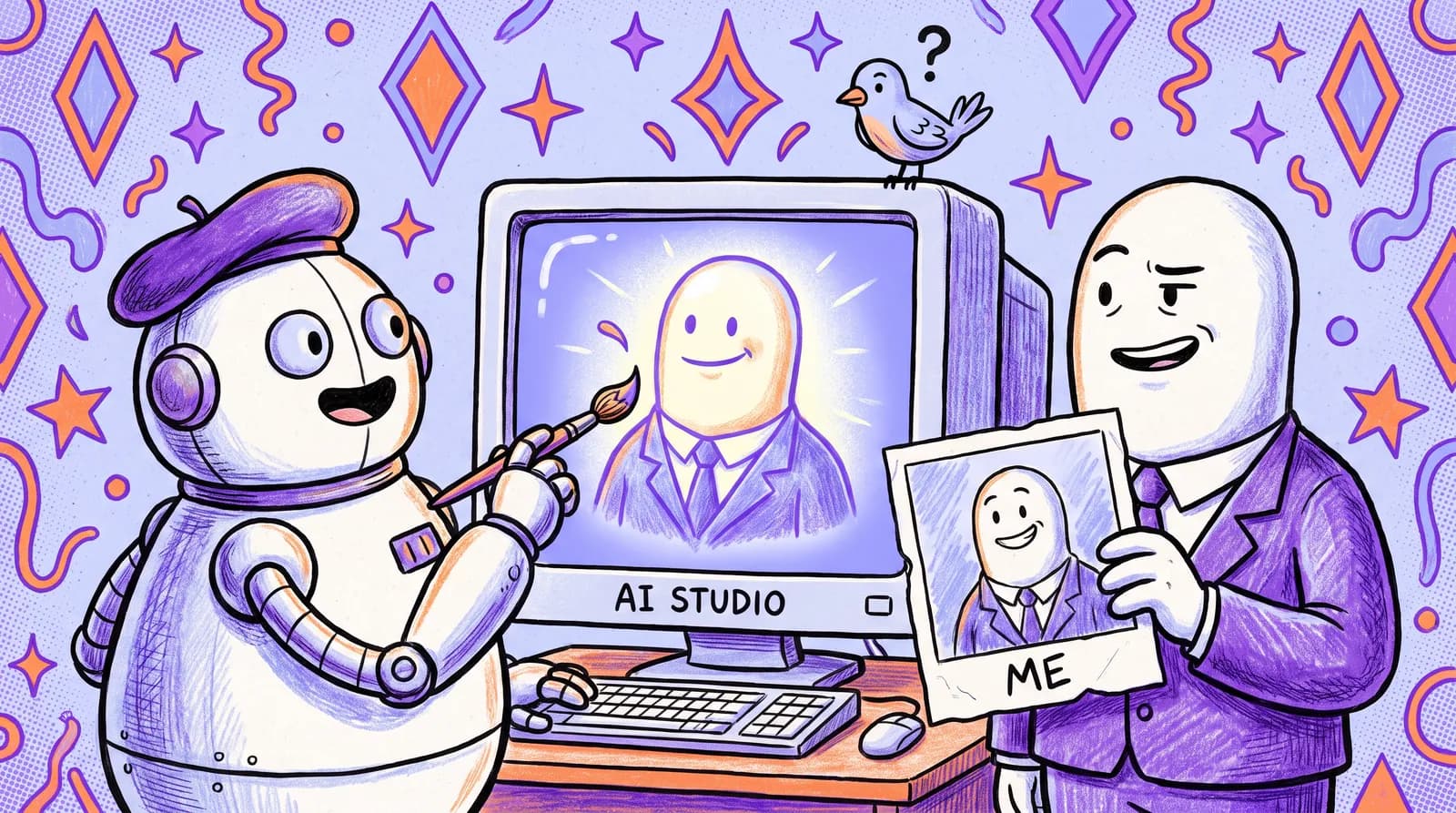
It's a Tuesday afternoon in mid-2026, and Rachel, a senior recruiter at a Fortune 500 tech company, is doing what she does best: scrolling through LinkedIn profiles. She's 200 deep today. Somewhere around profile number 140, a quiet realization hits her. She can no longer tell which headshots are AI-generated and which were taken by a human photographer. The lighting is too good. The backgrounds are too clean. The smiles are too polished.
Then comes the harder question: does it even matter?
This is the authenticity paradox of 2026. AI headshots have gone from a novelty to a norm in roughly 18 months. Yet the professional world hasn't agreed on what that shift means for trust, identity, and first impressions. The very tool that makes someone look more "professional" can, in certain contexts, make them seem less trustworthy.
What follows is a framework for navigating that, whether you're a job seeker, a hiring manager, or someone trying to work out whether their LinkedIn photo is helping or hurting.
The numbers don't lie: How AI headshots took over LinkedIn
The growth has been staggering. According to a May 2026 report by Visual Tech Insights, AI-generated images now account for an estimated 15% of all profile photos on LinkedIn globally, up from just 4% in early 2024. And that's the conservative number. Industry estimates suggest that over 60% of newly uploaded profile photos since January 2026 show significant signs of AI enhancement or full generation.
What caused the flood? Three forces converged at once.
First, affordability. A professionally shot headshot in a major metro area still runs $150 to $500. An AI headshot package from a tool like Starkie AI generates 200+ variations for $25 to $49. That's the cost of a decent lunch.
Second, remote work stuck around. Bureau of Labor Statistics data from March 2026 shows that 32% of professional service roles remain fully remote or remote-first. When your colleagues and hiring managers only ever see you on a screen, your profile photo becomes your handshake. Digital-first interactions made digital-first photos feel natural.
Third, the cultural barrier collapsed. In 2020 you booked a photographer, chose an outfit, drove to a studio and spent three hours getting a headshot, for around $300. In 2026 you upload five selfies in your pajamas, wait 15 minutes, and pick from dozens of polished results for $29.

There's also a quieter story buried in the data. Professionals in lower-income brackets, freelancers in emerging markets, and career-changers with no "corporate photo" in their history have adopted AI headshots most rapidly. For them, this isn't vanity. It's access. A graphic designer in Lagos and a product manager in San Francisco can now present themselves with the same visual polish. The playing field looks different than it did two years ago.
What recruiters and hiring managers actually think (the data is surprising)
You might assume recruiters hate AI headshots. The reality is messier.
A Q4 2025 survey by SHRM found that 48% of hiring managers and recruiters viewed detected AI headshots negatively, citing concerns about candidate transparency. But 52% said photo quality mattered more than photo origin, preferring a polished AI photo over a grainy real one.
The dividing line isn't "AI vs. real." It's "good AI vs. bad AI."
Recruiters have gotten good at spotting badly generated headshots. According to interviews published by Talent Acquisition Weekly in June 2026, hiring teams are now trained to flag four bad-AI markers: hyper-symmetry, where the face is too balanced and looks almost mirrored; over-smoothed skin with no pores or texture; the glassy-eye effect, where eyes lack depth or a coherent light catch; and background hallucinations like distorted bookshelves and impossible office furniture.
"A real, slightly blurry photo taken with a phone is fine," said Sarah Jenkins, Head of Talent at Apex Tech Solutions, in a June 2026 interview. "But when we see the hyper-smooth, glassy-eyed look of bad AI, we immediately start questioning what else is exaggerated on the resume."
The counterpoint is that well-executed AI headshots from good tools often outperform real photos in A/B tests for "approachability" and "professionalism" scores, particularly when the real photo was taken in poor lighting, a casual setting, or five years ago.
Context matters too. A recruiter hiring for a creative tech role responds very differently to an AI headshot than one hiring for a clinical social worker. Trust cues are profession-specific. The composite sentiment from recruiter focus groups? "I don't care if it's AI. I care if it looks like you and if it looks like you take yourself seriously."
The trust science: Why our brains struggle with "too perfect"
The tension between quality and authenticity isn't just a cultural debate. It's baked into our neurobiology.
Research on "thin-slicing," a concept explored in foundational work by Willis and Todorov (2006) and confirmed by updated meta-analyses through 2025, shows that humans form lasting judgments about competence, warmth, and trustworthiness within 100 milliseconds of seeing a face. A tenth of a second. Your brain was making hiring decisions before your conscious mind even finished loading the page.
The problem? This mechanism was calibrated for real faces, not optimized ones.
A 2025 study in the Journal of Social Psychology tested responses to three categories of LinkedIn photos: a good real photo, a hyper-symmetric AI photo, and a mediocre real photo. The results were revealing. The hyper-optimized AI photo scored highest on attractiveness but lowest on perceived warmth and relatability. Participants described those faces as "unapproachable" or "dishonest."
Why? A genuinely warm face shows natural, asymmetric muscle movement. A real Duchenne smile doesn't look the same on both sides. When AI creates a "perfect" smile by mirroring both halves of the face, something feels off. Your brain knows, even if you can't articulate it.
But here's where it gets interesting. Emerging research suggests that when professionals proactively disclose their photo is AI-assisted, trust scores don't drop. In some demographics, they actually rise, signaling transparency and tech-savviness.
The goalposts for "authentic" have shifted. In 2026, audiences understand filters, retouching, and brand photography. A well-lit, expressive AI headshot may be no less "real" than a professionally retouched studio portrait. The better question isn't "real vs. fake." It's: does this image accurately represent who I am and how I want to show up professionally? That question applies equally to every headshot, regardless of how it was created.
Two professionals, two outcomes: What made the difference
Two representative scenarios from common market feedback in 2026 make the difference concrete.
Maria, a mid-career software engineer transitioning into product management, had been using a blurry conference selfie from 2019 as her LinkedIn photo for years. She used Starkie AI to generate a business-casual headshot, uploading multiple recent selfies taken in natural light. The result looked exactly like her, just with better lighting and composition. "I needed to look like a modern PM, not a coder in a dark room," she said. "The AI didn't change my face. It changed my lighting." Within 60 days, her InMail response rate from recruiters increased noticeably.
David, a financial advisor, wanted to project maximum trustworthiness to attract high-net-worth clients. He used an AI tool that let him describe the output: "confident business leader, impeccable suit, perfect hair, modern skyscraper background." The result looked like a stock photo. His bone structure was technically there, but with pores erased, eye color intensified, and impossibly perfect hair. Clients who had met David in person reported confusion. One prospect mentioned, "His LinkedIn photo looks like a character model for a game about finance. It made me hesitate about his transparency."

Three variables separated the two outcomes. Likeness fidelity: does the image actually look like you? Contextual appropriateness: does the style match your industry and role? And expression: does it convey the person behind the job title?
AI headshots fail not because they are AI. They fail because they prioritize aesthetic optimization over authentic representation. The best tools are designed to enhance the real person, not replace them.
Where LinkedIn and professional platforms stand
As of mid-2026, LinkedIn does not explicitly ban AI-generated profile photos. Its Professional Community Policies, updated in January 2026, require profiles to "accurately represent you, a real person." This creates a gray zone. If an AI photo looks exactly like you, it's likely permitted. If it's an optimized version that doesn't resemble you, it arguably violates the policy. Enforcement remains reactive, driven by user reports rather than automated detection.
LinkedIn has invested heavily in a different trust signal instead. Its "Verified" badge program has expanded aggressively. As of June 2026, 25% of active global users have completed ID verification to earn the blue shield. This partly sidesteps the photo debate entirely. A verified profile using an AI headshot is often perceived as more trustworthy than an unverified profile with a real photo.
Beyond LinkedIn, norms are developing elsewhere. Professional Slack communities, GitHub profiles, and industry-specific platforms are beginning to develop informal guidelines around AI imagery. The Coalition for Content Provenance and Authenticity (C2PA) is building the technical infrastructure for metadata markers that could automatically identify AI-generated images.
Within 12 to 18 months, expect LinkedIn to introduce an optional AI-generated photo disclosure label, similar to how content labels emerged for AI-written articles. Professionals who get ahead of this norm voluntarily will position themselves as forward-thinking, not deceptive.
There's also an uncomfortable tension for LinkedIn itself. The platform profits from engagement. Higher-quality photos increase profile views, connection requests, and time on platform. AI headshots are good for LinkedIn's metrics, even if they complicate its authenticity mission.
Using AI headshots ethically: The transparency playbook
If you're going to use an AI headshot, and for many professionals that's the right call, five principles keep it honest.
Likeness comes before polish. Your headshot has to pass the coffee shop test: if a connection met you for coffee, would they recognize you instantly? This is non-negotiable. Use tools that require multiple diverse input photos so the AI learns your actual facial geometry, not a generic template.
Match the context. A headshot that works for a startup founder isn't the one for a hospital administrator. Audit the visual norms of your specific professional world. An over-optimized suit photo for a creative director looks as out of place as a beach selfie does for a partner at a law firm.
Disclose proactively where the stakes are high. In healthcare, legal, financial advising or therapy, consider a simple note in your About section: "Profile photo generated with AI assistance." Research suggests this actually enhances trust among transparency-conscious audiences.
Update it regularly. An AI headshot should reflect your current appearance, not how you looked two years ago. A dated AI headshot creates the same disconnect as any outdated photo.
And use a tool that respects your identity, because not all AI headshot generators are equal. Tools like Starkie AI are built to preserve your features, expressions, and individuality rather than smoothing them into a generic professional template. This is the technical foundation on which ethical use rests.

The decision framework: When AI helps vs. when it hurts
Two axes decide it: how trust-sensitive your role is, and how strong your current photo is.
An AI headshot is a clear win if you have no professional photo at all, if your existing one is three or more years old or was taken somewhere unprofessional, if you work in tech, creative, startup or remote-first environments, if you're entering a new industry and need a visual rebrand, or if you're a new graduate on a limited budget.
Proceed carefully in mid-level corporate roles where visual culture fit matters, in client-facing roles with moderate trust sensitivity, and anywhere your profile will sit alongside frequent in-person interaction, which makes likeness fidelity critical.
Skip it, or take extreme care, in roles where personal trust is the core product (therapists, clergy, financial advisors serving vulnerable populations), on platforms where AI disclosure is required or expected, and when you already have a strong, recent real photo that performs well.
The useful reframe: an AI headshot helps when it narrows the gap between how you want to be perceived and how you currently are. It hurts when it opens a new gap between the optimized digital version and the physical one.
The question was never whether AI headshots are cheating. It's whether your profile photo is doing its job.
Back to Rachel
Rachel, the recruiter from the opening, isn't unsettled by AI headshots once she has this framework. She's asking better questions. Does this photo look like a real, specific person? Does it reflect the professionalism and warmth the role requires? Does the overall profile feel coherent and honest?
The authenticity paradox resolves itself when you stop equating "authentic" with "unedited" and start equating it with "accurately representative." A blurry selfie taken in a dim apartment is not more authentic than a well-generated AI headshot if neither one shows you at your professional best.
Your profile photo has one job: to represent you, compellingly and honestly. AI is just one tool to get there. Used well, it levels an uneven playing field. Used carelessly, it erodes exactly the trust you're trying to build.
If you're ready to see what an AI headshot that actually looks like you, on your best professional day, can do for your profile, Starkie AI was built exactly for that.