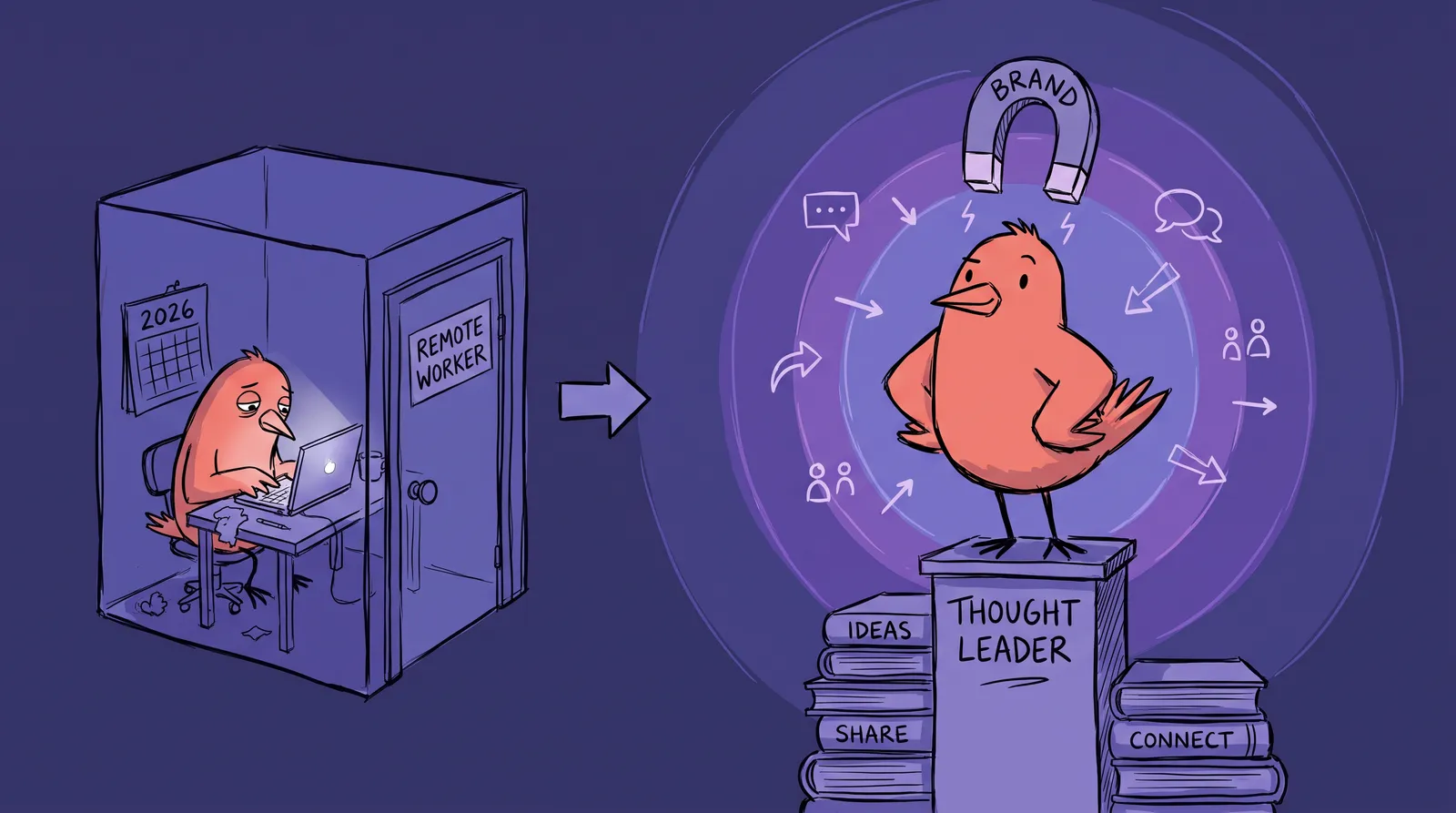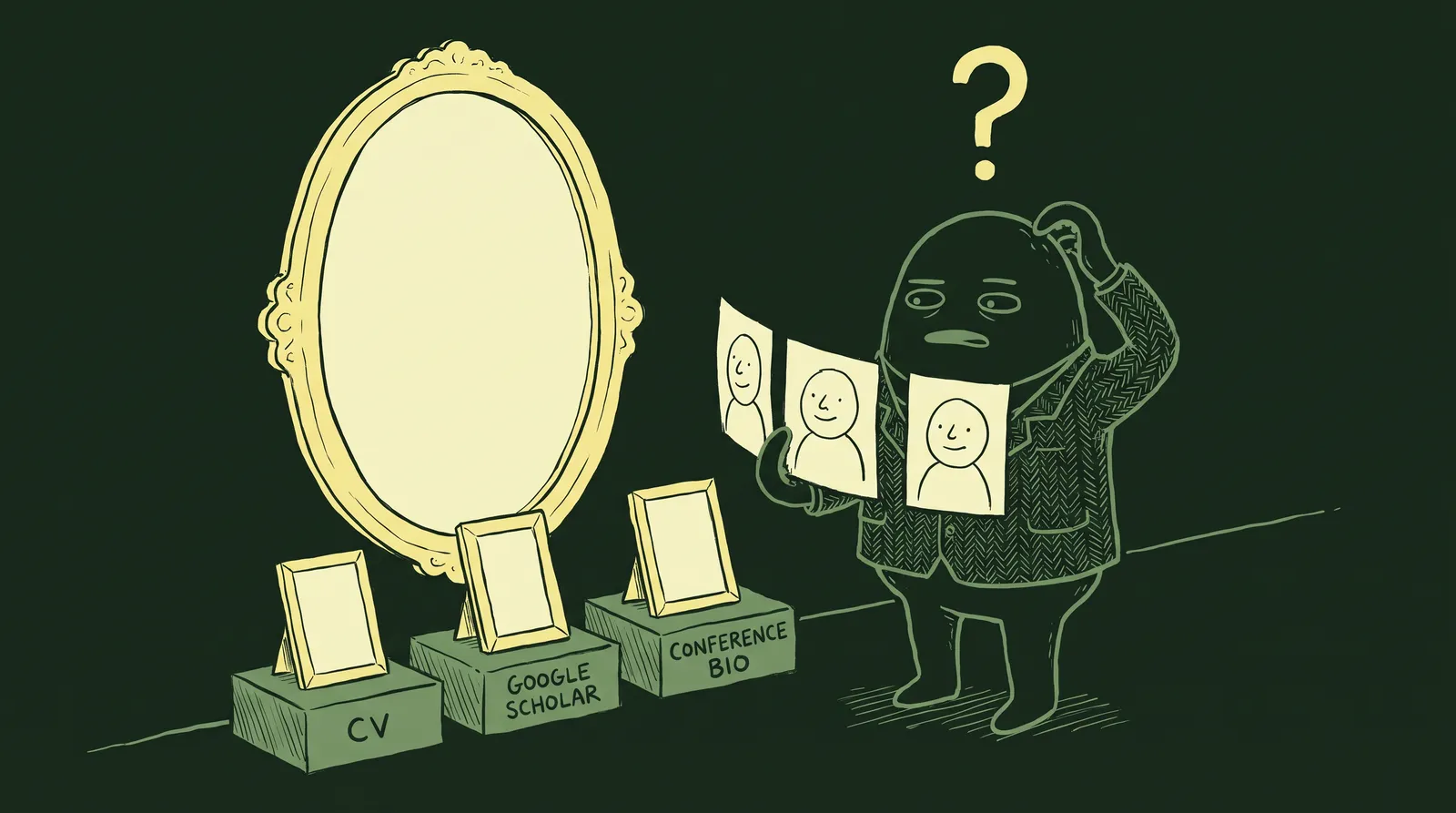
A PhD student defends her dissertation, updates her CV with a new title, and walks straight past the one line that still says "graduate student" under a photo from her first year of the program. Six years, a dissertation, and two conference papers later, and the department website still shows the person she was before any of it happened.
That gap is more common than it should be. Corporate professionals get nudged to refresh their LinkedIn photo every couple of years. Academics get no such nudge. A faculty photo goes up once, usually during onboarding, and then sits untouched on a department page, a Google Scholar profile, and a dozen conference programs until someone notices it looks nothing like the person at the podium.
This matters more than vanity. Research on how faces shape first impressions in the classroom, and practical guidance from university libraries on what your research profiles actually need, both point the same direction: the photo attached to your academic identity is doing more work than most researchers assume.
Why academic headshots follow different rules than corporate ones
A LinkedIn photo has to work for one platform, for maybe two years, in front of recruiters who spend a few seconds on it. An academic headshot has to work across a Google Scholar profile, an ORCID-linked page, a faculty directory, a conference program, and a decade of citations, sometimes without ever being replaced.
That longer shelf life changes what "professional" means. A research guide from Stanford's Lane Medical Library, written for researchers setting up their online presence, tells them plainly to "upload a professional headshot" to Google Scholar, the same instruction a corporate onboarding email would give. But the register is different. A headshot that reads as "trying to sell something" fits badly next to a list of peer-reviewed publications. Academic norms lean toward approachable and understated over polished and salesy, which is part of why so many faculty photos default to a slightly awkward department-hallway snapshot instead of a studio session.
There is also a practical constraint corporate workers rarely face: appearance changes fast during the years when academics need a photo least. A first-year PhD student, a postdoc between fellowships, and a newly tenured associate professor can look like three different people, and grad student budgets rarely include a professional photographer at any of those stages.
Where the photo actually shows up
Most researchers can name one place their photo lives. In practice it is scattered across half a dozen, each with different requirements.
Google Scholar. Your citation profile, the page most likely to outrank your own department bio in a search for your name, and the one place a professional headshot is explicitly recommended rather than just expected.
ORCID and department directories. Slower-moving than social platforms, but still the first thing a prospective student or collaborator sees when they look you up.
Conference programs and speaker bios. Submission portals for academic and professional conferences routinely spell out a minimum resolution. One aging-services conference's call for proposals asks for a headshot at "a high-resolution photo of 300 dpi," due alongside the rest of your proposal. Another event's speaker portal wants the same 300 dpi minimum, due as soon as you confirm you're speaking, which in practice means having a usable photo on hand before you even know you need one. It's the same scramble executives and public speakers run into outside academia, just with a conference program instead of a keynote slide deck.
Press and media requests. When a journalist needs a quote from a subject-matter expert, a usable headshot is part of what makes a researcher easy to cite instead of skipped over in favor of someone else with a ready photo and bio on file.
Your CV. This one is not universal, and getting it wrong sends an unintended signal in either direction.

The CV photo question nobody explains well
Whether a photo belongs on an academic CV depends entirely on where you are applying, and the rules are not intuitive if you have only ever job-hunted in one country.
In the United States, a photo is strongly discouraged under anti-discrimination law, including Title VII of the Civil Rights Act, and including one can lead to an application being rejected outright rather than read. The UK, Ireland, Canada, and Australia follow the same logic under their own frameworks, from the UK's Equality Act 2010 to Canada's Human Rights Act: recruiters in all four countries tend to reject or discard CVs that include a photo, specifically to avoid any appearance of bias. The Netherlands, Sweden, Norway, and Denmark land in the same place for the same reason, citing their own equal-treatment and discrimination laws.
Continental Europe is messier, and Germany is the clearest example why. The traditional Lebenslauf included a studio Bewerbungsfoto in the corner of the first page, and plenty of applicants still send one. But Germany's General Equal Treatment Act now makes appearance-based hiring decisions a legal liability for the employer, which means the photo has quietly gone from expected to optional, even though the old habit lingers in more traditional industries. France runs similar: a photo is still common but no longer required. Spain treats it as optional outright.
The practical upshot for a researcher applying internationally: a photo-free CV is the safer default almost everywhere now, including in the countries where it used to be standard. Adding one only makes sense when you know the specific institution or industry still expects it, and even then, the trend line points toward leaving it off.
What the research says about faces and academic judgment
The idea that a photo shouldn't matter to academic credibility runs into a body of research showing it does, at least in the classroom.
A 2006 study in the Journal of General Psychology pulled data from RateMyProfessors.com and compared professors students rated as physically attractive against matched control groups in the same department and gender. Across four separate universities, professors perceived as attractive scored about 0.8 of a point higher on a five-point evaluation scale. That's a meaningful gap on a scale that only runs from one to five.
A follow-up line of research went further in isolating cause from correlation. Economists Babin, Hussey, Nikolsko-Rzhevskyy, and Taylor tracked the same instructors teaching both face-to-face and online, where physical appearance is far less visible to students. They found a real beauty premium in evaluations of female instructors' in-person classes, and it disappeared almost entirely once the same instructors moved online. Because the instructor's actual teaching did not change between the two formats, the researchers concluded the effect looks like discrimination shaping perception, not a genuine difference in teaching quality that a photo happened to reveal.
A separate experiment out of the University of Nevada, Las Vegas pushed the question from ratings into actual learning. Researchers played the identical 20-minute audio physics lecture to more than 100 students, showing half of them a photo described as an attractive lecturer and the other half a photo described as unattractive, with no other difference in what they heard. Students who saw the "attractive" photo averaged 18.27 correct answers on a comprehension quiz, against 16.68 for the group shown the "unattractive" photo, on the exact same test.
None of this means researchers should chase conventional attractiveness. It means a photo that looks approachable and current, rather than dated or awkward, is not a cosmetic detail. It appears to shape how carefully an audience pays attention before a single word gets said, in much the same way split-second judgments from a photo shape a hiring manager's read on a LinkedIn profile.

The faculty page problem, and why nobody fixes it
Corporate photo refreshes happen because someone owns the process. HR mandates a new headshot at onboarding, and a manager might flag it during a rebrand. Academia has no equivalent structure. A photo goes up once, during a hire or a new degree, and then nobody is assigned to notice when it stops matching the person.
The result compounds over a career. A professor who joined a department at 29 might still have that same photo at 45, at 52, at retirement. Students meeting a professor for the first time based on a fifteen-year-old faculty photo experience something close to a small trust gap the moment they walk into office hours and the person in front of them doesn't match the one they expected online. It is a minor moment, but it is exactly the kind of "does this profile match reality" check that Google Scholar's own guidance is trying to help researchers get right in the first place, just extended to every other page carrying that same photo. Founders chasing investor trust run into the same split-second calculus with their own LinkedIn photos, just compressed into a single funding pitch instead of a whole career.
The fix is not complicated. It is scheduling. One headshot-industry guide breaks down recommended refresh intervals by field, and education comes out near the slow end at every two to five years, well behind healthcare or law, but the same guide lists clear triggers that override any schedule: a changed hairstyle, a new title, or the simplest test of all, a colleague doing a visible double-take on a video call because you look different from your photo. For an academic, that means picking a fixed point, a new semester, a promotion, a sabbatical return, and treating the photo update as part of the paperwork rather than something that happens only if you happen to think of it.
What actually makes a good academic headshot
A few things distinguish a photo that works across a Google Scholar profile, a faculty page, and a conference program from one that only works in one of those places.
Recency matters most. A photo from within the last two or three years keeps you recognizable to a colleague meeting you at a conference after seeing only your profile picture online. A photo from a decade ago, however flattering, has stopped doing its job.
A neutral or softly blurred background travels better than a busy office or a branded backdrop, since the same image often gets cropped square for one platform and wide for another. Business casual or field-appropriate formal wear reads as intentional without tipping into a look that feels mismatched with a research profile. A relaxed, natural expression outperforms a stiff, camera-ready smile, largely for the same reason the classroom research above points to: it reads as approachable rather than performative, and approachable is closer to what most academic contexts actually reward.
Consistency across platforms is the piece most researchers skip entirely, the same cohesive-visual-brand problem freelancers and consultants solve for LinkedIn, Twitter, and a personal site. Using the same photo, or at least photos from the same sitting, on Google Scholar, a department page, and a conference speaker bio removes the mismatch that makes a search committee or a journalist wonder if they have the right person.
Getting a usable set of options without booking a studio session is where a tool like an AI headshot generator can help, particularly for graduate students working with a tight budget and a look that keeps changing year to year. A generator like Starkie can turn one decent phone photo into several professional options, which solves the specific problem of needing a passable headshot on short notice for a conference deadline without waiting weeks for a photographer's calendar to open up.
Put it on your own calendar
Nobody in a university administration is going to email you about your Google Scholar photo. That email doesn't exist, and it never will, because no office owns this the way HR owns onboarding photos in a corporate job. The classroom research above suggests that gap has a real cost: a current, approachable photo shapes how an audience listens before anyone says a word. The CV research suggests a second cost, the wrong call on whether to include a photo at all reads as unfamiliarity with local hiring norms.
Both problems have the same fix. Pick a date, every few years or whenever your title changes, and use the same photo everywhere it needs to appear. It's a small task with an outsized shelf life, given how long one photo ends up representing you.