A real estate agent's headshot does more work than almost any other professional photo. It sits on a yard sign at 18 inches tall, in a Zillow profile the size of a thumbnail, on a business card, a bus bench, a farming postcard, and a LinkedIn banner, often all at once. Most people update that photo once, forget about it, and never think about it again. That's a mistake, because buyers are forming an opinion about you from that photo before they've read your bio, checked your reviews, or heard you say a word.
Your headshot works harder than any other professional photo
An agent's headshot has to work everywhere a listing might reach a buyer, not just one or two places. A lawyer's headshot lives on a firm website. A consultant's lives mostly on LinkedIn. An agent's photo has to hold up on the yard sign in front of the house, the Zillow and Realtor.com agent profile, the Homes.com listing page, a brokerage roster page, a farming postcard mailed to the neighborhood, a bus bench ad, a business card handed over at an open house, and every social platform used to market a new listing.
Each of those surfaces has different size constraints and different viewing distances. A photo that reads clearly on a phone screen from six inches away can turn into a blur when it's blown up 18 inches tall and viewed from a moving car. Most professionals only have to solve for one or two contexts. Agents have to solve for all of them with a single image.

What buyers actually decide in the first tenth of a second
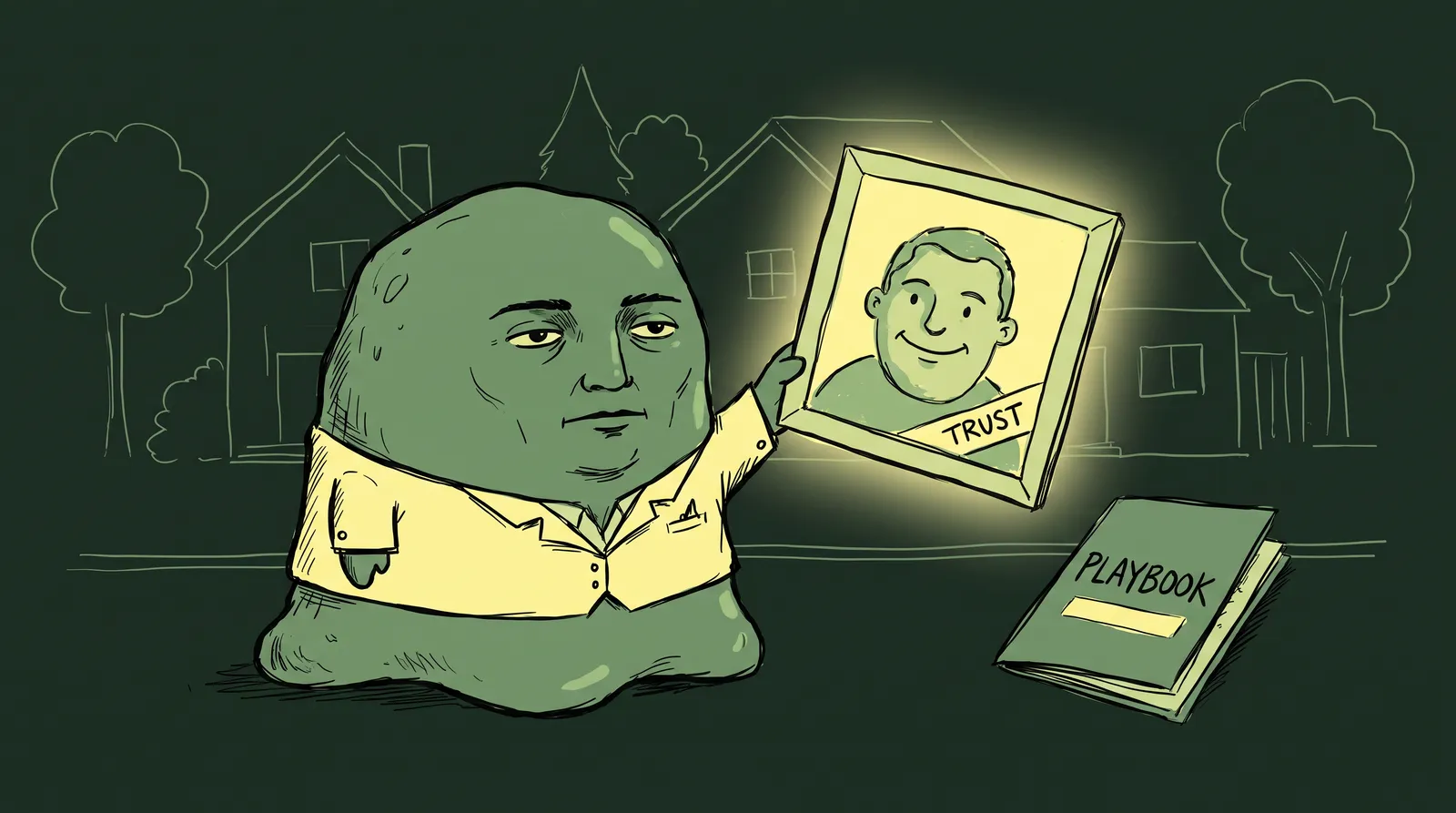
Buyers decide whether to trust your face before they read anything else about you. Princeton researchers Janine Willis and Alexander Todorov found that people form a trustworthiness judgment about an unfamiliar face after seeing it for just 100 milliseconds, a tenth of a second. Giving people more time to look, up to a full second, barely changed the judgment itself. It mostly made people more confident in the snap decision they'd already made, according to the American Psychological Society's summary of the research.
That finding matters more for real estate than for most professions, because so much of the industry now starts online. Eighty-eight percent of home buyers used a real estate agent or broker to purchase their home, and 43 percent said browsing listings online was their first step in the process, according to the National Association of Realtors' 2024 Profile of Home Buyers and Sellers. A large share of those buyers are scrolling past your photo on a phone screen, forming a trust judgment about you, long before they ever pick up the phone.
The $20,000 photo: what a decade of listing data says about agent photos
A single photo can move the price tag on a listing before a buyer ever meets the agent behind it. Researchers Frank Mixon, Sean Salter, and Ernest King pulled Multiple Listing Service data from June 2000 through November 2007, then had 402 real estate agent website photos independently rated for physical attractiveness on a scale of 1 to 10. When they matched those ratings back to the sales data, the pattern held up: agents rated as more attractive listed homes for about $20,275 more, on average, than agents rated as average-looking, and sold those homes for about $15,622 more, according to ScienceDaily's coverage of the study. Every additional point on the 1-to-10 attractiveness scale added roughly $10,989 to the listing price and $8,467 to the sale price.
There's a catch, and it's the more useful part of the finding. The more attractive agents also carried 17 fewer listings and closed 11 fewer sales than their average-looking counterparts, and their homes took longer to sell. The researchers suggested that some attractive agents lean on their looks instead of the legwork that actually generates listings.
Agents shouldn't take this as a reason to chase good looks. What it actually shows is that a photo isn't neutral: it's already shaping how polished and capable you appear on paper before a buyer has met you, negotiated with you, or watched you handle an inspection dispute. A sharp, current, professional photo won't replace the work of finding and closing listings, but it removes a quiet disadvantage that a dark, outdated, or amateur photo creates before you've even started. That's the same logic behind why independent consultants treat their headshot as a client-winning asset rather than an afterthought: the photo is doing sales work long before anyone picks up the phone.
Designing a headshot that survives being printed 18 inches tall on a lawn
A headshot built for a screen doesn't automatically survive being printed on a lawn sign and viewed from a moving car. Most professional headshots only ever need to hold up close, on a screen or in an interview. An agent's headshot also has to hold up at a much larger size and a much greater distance.
The residential standard yard sign size is 18x24 inches, a size that fits standard frames and H-wire stakes and clears most HOA restrictions without a fight, according to YardSignPlus's guide to real estate sign sizes. Busier roads or deeper setbacks call for a 24x30 or a 24x36. The rule of thumb the guide gives is that every inch of letter height buys roughly 10 feet of readable viewing distance, which is exactly why a photo that's sharp on a screen can go muddy at sign size: fine details like subtle shadows or a busy background simply don't survive the enlargement.

That means the same headshot decisions that look fine in a Zillow thumbnail can backfire on a sign. A cluttered background competes with your face rather than framing it. Low contrast between your clothing and the backdrop makes the whole photo read as one gray blur from the street, and a design with a name, a phone number, and a brokerage logo alongside your face needs a bigger sign, not a smaller photo, according to the same YardSignPlus guide, which recommends stepping up to a 24x30 or 24x36 before shrinking anything to make room.
One photo, six platforms: keeping your look consistent everywhere
Yes, agents should use the same headshot everywhere, not a different one per platform. That photo shows up on Zillow, Realtor.com, Homes.com, a Google Business Profile, Instagram, LinkedIn, and a personal website, often within the same week a new listing goes live. Zillow's technical bar is low: the file needs to be at least 180x180 pixels and saved as a JPEG, according to The Close's guide to building a Zillow agent profile. The bigger risk isn't the file spec. It's using a different photo on every platform.
A photo that's dark, blurry, or obviously cropped from a group shot signals that you haven't invested much in your own presentation, and using the same professional photo everywhere, from Zillow to your Google Business Profile to Instagram, reads as organized and intentional rather than scattered, according to Reflecting Walls' guide to optimizing realtor profiles. The same guide recommends refreshing that photo at minimum every two years, or sooner if your appearance changes noticeably. If a client has only seen your photo online and doesn't recognize you when you show up for a listing appointment, the photo has already worked against you.
Buyers are also paying attention to more than the static photo. Zillow's own Consumer Housing Trends research found that buyers, particularly younger buyers and those in the Northeast, favor agents who maintain an active social media presence, and a growing share of buyers now research an agent online before ever reaching out, according to reporting on the report. A consistent headshot is what ties all of that scattered research back to one recognizable, trustworthy person.
If building that kind of consistent visual presence across platforms feels like a design problem more than a photography one, it's worth reading how other independent professionals have approached building a cohesive visual brand across platforms without hiring a designer. A lot of the same logic that applies to a freelancer's LinkedIn and portfolio site applies just as directly to an agent's Zillow, Realtor.com, and Instagram profiles.
Where AI headshots fit, and where the rules run out
AI headshot generators are a legitimate shortcut for agents who need a current photo without booking a studio session. Getting a new headshot used to mean scheduling a shoot, which costs money and time that a busy agent doesn't always have between showings and closings. Tools like Starkie AI have become a fast, inexpensive way to get a current, professional-looking photo instead, and they're worth considering the same way freelancers and other one-person businesses have started using them to build a consistent, polished look across every platform they need a photo for.
Real estate has also started running into the harder question of how much AI editing is acceptable in marketing, just not for headshots yet. California's Assembly Bill 723, effective January 1, 2026, became the first state law written specifically for digitally altered real estate marketing images, and it requires disclosure whenever an edit adds, removes, or changes elements like furniture, flooring, landscaping, or a property's exterior, according to The Close's coverage of the new rule. That law, and the MLS rules following it, are aimed squarely at listing photos of the property itself. None of them currently say anything about an agent's own headshot.
That gap doesn't mean anything goes. It means the accuracy bar for your own face is still self-policed rather than regulated, which is the same standard other professionals weigh when deciding whether an AI headshot still looks like them. The practical test holds regardless of what generated the photo, camera or AI: if a buyer who has only seen your headshot wouldn't recognize you walking up to a showing, the photo has failed, and no platform's technical rules will save it.
The photo is doing its job before you say a word
An agent's headshot isn't vanity, it's marketing collateral that gets asked to do more than almost any other professional photo: read clearly at thumbnail size and at yard-sign size, build trust with a stranger in a tenth of a second, and stay recognizable across half a dozen platforms for years at a time. Buyers form a judgment about you from that photo before you've said a word, and the research on agent photos suggests that judgment is worth more, in dollars, than most agents assume. Getting the photo right won't replace the work of winning and closing listings, but it stops that photo from working against you before the work even starts.