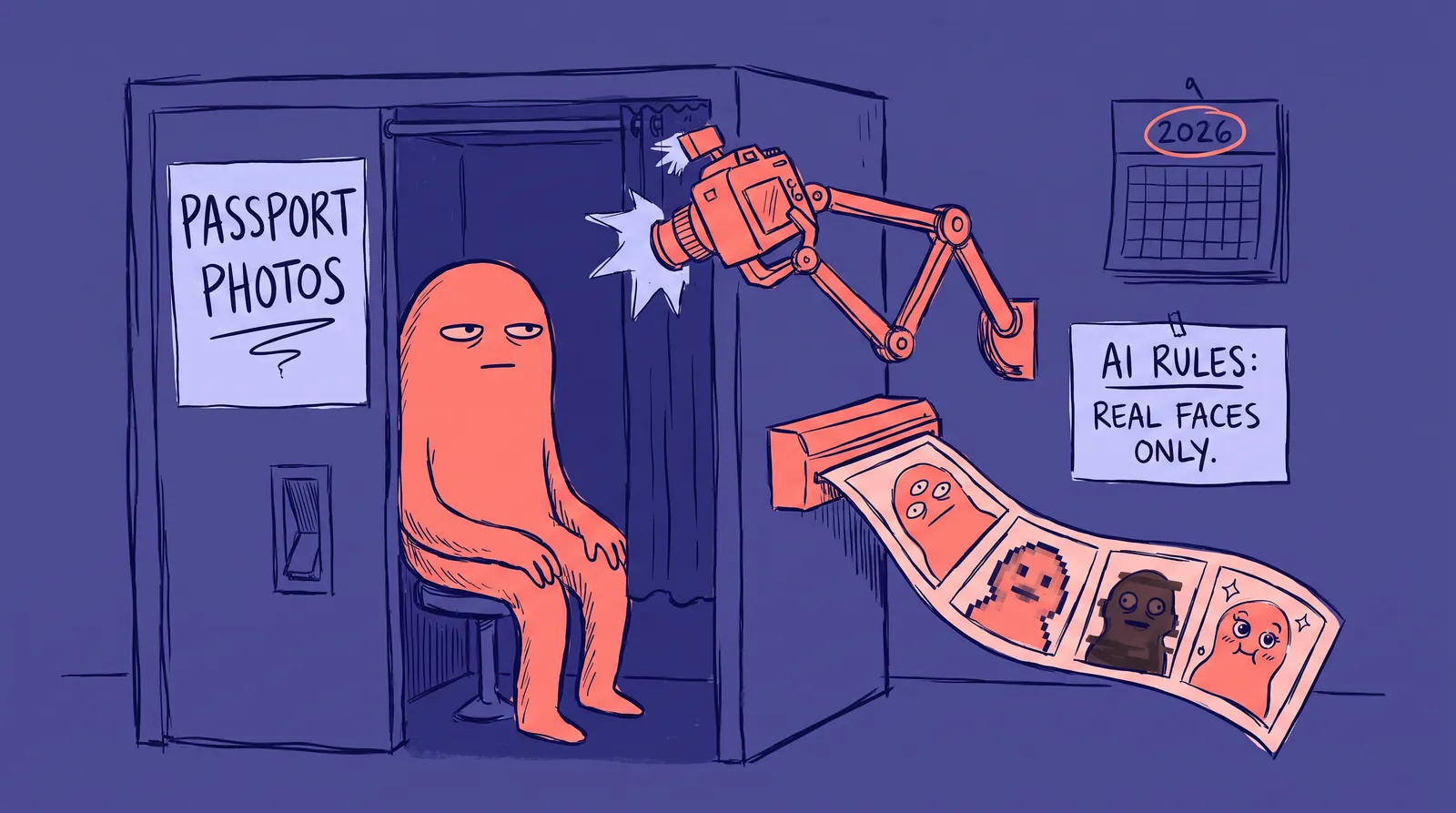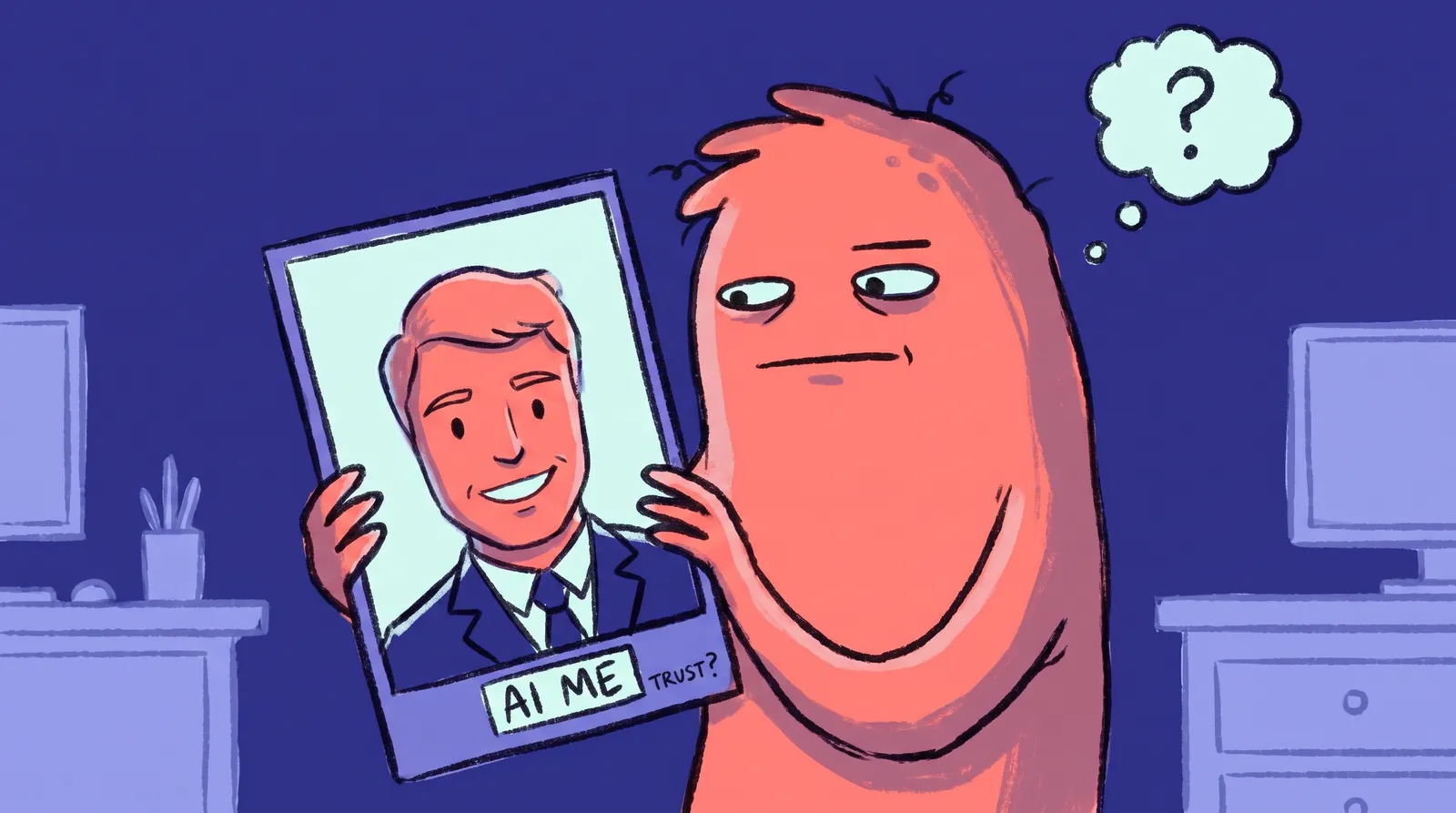
A recruiter at a mid-sized tech firm scrolls through LinkedIn applications. One candidate stands out. The headshot is crisp, well-lit, and confident. But something feels slightly off. She can't quite name it. She sends the photo to a colleague. They both shrug. She hires the candidate anyway, and the photo turns out to be AI-generated.
Was that a problem? Should it have been?
This scenario is no longer unusual. Industry analysts estimate that over 40% of new LinkedIn profile photos uploaded in early 2026 are AI-generated or AI-enhanced. And according to a Ringover survey, while 80% of recruiters believe they can accurately spot an AI headshot, they only correctly identify them 39.5% of the time. That's worse than flipping a coin.
The line between "real" and "generated" has blurred to the point where the more interesting question isn't "can we tell the difference?" but "does the difference still matter?"
What follows covers the visual clues that still betray AI images, the detection tools trying to keep pace, the ethical gray zones, and what platforms and employers are actually doing about it in 2026.
The tell-tale signs: Visual artifacts that still give away AI headshots
High-end AI headshot generators have largely conquered the uncanny valley. But artifacts persist, especially with lower-quality tools or when you inspect images at full resolution.
Skin texture remains the most common giveaway. AI-generated skin often looks hyper-smooth, almost waxy. Pores are either too uniform or missing entirely. Real photos captured under studio lighting show natural shadow variation across pores, fine lines, and micro-textures that cheap generators simply erase. Some newer tools like HeadshotPro have started explicitly preserving "microscopic pores and grit" to counter this tell, but many generators still default to plastic-looking perfection.
Eye reflections are the next checkpoint. In a real photograph, the catchlight (that small white reflection of the light source in each eye) is consistent across both eyes and matches the direction of the ambient or studio lighting. AI models frequently generate mismatched or symmetrical catchlights that don't correspond to any plausible light source. Tip: zoom into both eyes and compare the reflected shapes. If one eye reflects a window and the other reflects a softbox that doesn't exist, you're likely looking at a generated image.
Jewelry, glasses and accessories remain a consistent weak point. Earrings may lose symmetry or appear duplicated on one side. Necklace chains can blur or merge with the collar. Glasses frames sometimes warp at the temples, and one lens might reflect an entirely different scene than the other. As AI imaging expert Naveen Gupta noted in a late 2025 analysis, "Earrings, glasses, and teeth are still occasional problem areas. Always zoom in and check."
Hair-to-background transitions are notoriously tricky for generative models. Look for slight color halos around fine or wispy strands, blurred strand definition at the edges, or backgrounds with a "painted" bokeh that doesn't follow real optical physics. A genuine lens creates depth of field through glass optics; AI approximates it, and the approximation often breaks down where hair meets background.

How AI detection tools work, and why they're already struggling
Detection approaches in 2026 fall into three broad categories.
Metadata analysis examines EXIF data for the absence of camera device info, compression signatures, or geolocation markers. Research from 2025 suggested metadata-only approaches could reach around 89% accuracy by identifying mismatches in camera models and compression patterns. But here's the catch: the best AI headshot generators now sanitize or synthesize plausible EXIF metadata, including fake device info and camera make/model data, specifically to evade automated detection.
Frequency-domain analysis uses techniques like Fast Fourier Transform (FFT) combined with convolutional neural networks to detect subtle spectral fingerprints left by GANs or diffusion models. These anomalies are often invisible in the pixel domain but show up in the frequency domain. Studies show FFT combined with models like MobileNet can push accuracy to 94.2% on controlled test sets. That sounds impressive until you consider what happens next.
Behavioral heuristics take a different approach entirely. Platforms flag signals like newly created accounts uploading profile photos with no prior upload history, or image characteristics that don't match typical user behavior patterns.
All of it runs into the same problem: this is an adversarial arms race. As detection tools improve, generative models are trained against them. Even the strongest publicly available detectors in 2026 hover around 85 to 91% accuracy on controlled test sets. Real-world accuracy drops significantly when images are resized, compressed, or filtered, which happens automatically on virtually every social platform. And false positives carry real consequences: a real photo flagged as AI-generated can damage a person's professional reputation.
Notable tools like Hive Moderation and Illuminarty each bring trade-offs. Tools trained primarily on GAN outputs often struggle with the latest diffusion-based headshots, and vice versa. LinkedIn has begun piloting its own platform-native detection signals, but even these are supplementary rather than definitive.
Detection tools work as a first filter and cannot serve as the final word. Human judgment and context still matter enormously.
When a fake headshot made headlines, and what it revealed
Consider a scenario representative of a growing category of real incidents. During a corporate brand refresh, a mid-level executive at a financial services firm discovered that her corporate directory photo had been replaced with an AI-generated version, without her knowledge or consent. The marketing team had processed headshots in bulk through an AI tool to ensure visual consistency across the company directory. Internal colleagues noticed subtle anomalies in her image. The story leaked to a trade publication and sparked a small PR crisis around "authentic corporate identity."
What made this incident instructive wasn't the technology. It was the institutional blind spots it exposed.
No review process existed to distinguish AI-generated photos from real ones during the bulk processing workflow. The employee felt her identity had been replaced without consent, raising legal questions under emerging likeness rights protections. California's AB 2602, effective since January 2025, specifically targets employers using AI-generated "digital replicas" without clear consent. The proposed federal NO FAKES Act, actively debated in 2026, aims to create broader protections against unauthorized digital replicas. And the EU AI Act, enforced since 2025, mandates transparency labeling for AI-generated media.
There's also a DEI dimension that many companies overlook. A 2026 review found that some AI headshot tools actively alter appearances toward Eurocentric standards, lightening skin tones or smoothing textured hair. For companies investing in diverse representation, tools that homogenize features create a values problem, not just a technical one.

The recruiter perspective adds another layer. TrueYouAI found that 73% of recruiters could not distinguish AI headshots from professional photos, confirming a definitive "quality threshold moment." Yet two-thirds of recruiters report being "put off" once they learn a candidate used an AI-generated headshot. The discomfort isn't about image quality. It's about trust.
Here's the uncomfortable counterpoint the financial services firm raised in its rebuttal: the AI headshots were objectively higher quality, better lit, and more visually consistent across the directory than the originals. Is "authentic but mediocre" actually better than "artificial but excellent"?
The gray zone: When AI headshots are totally fine (and even preferred)
Not all AI headshots are created equal, and treating them as a monolithic category misses important distinctions. There are three points on the authenticity spectrum worth separating.
At one end sit fully AI-generated faces of fictional personas. That's the only category involving actual identity deception, and it's rightly restricted in professional contexts.
In the middle sit AI-generated headshots of real people, trained on their own photos. Tools like Starkie AI work this way: you upload your own photos and the model generates polished headshots of you. The person is real, the likeness is accurate, and the tool is just the studio.
At the other end sit AI-enhanced real photos: background swaps, blemish removal, lighting correction. That's functionally identical to what retouchers have done for decades.
The professional photography parallel is worth sitting with. Traditional headshot photography has always involved heavy staging, makeup, lighting manipulation, and post-processing. A professionally retouched studio headshot from 2018 is no less "constructed" than an AI-generated one in 2026. The tool changed. The intent didn't. As executive photographer Brian DeSimone put it in early 2026, "A forte of professional photography is the experience and human connection... AI isn't in the room." That's a real trade-off, but it's about process, not about the legitimacy of the result.
The use cases where AI headshots aren't just acceptable but genuinely preferable keep growing: remote workers without access to professional photographers, early-stage founders building credibility on tight budgets, job seekers in competitive markets who deserve to look polished regardless of resources, and international professionals whose local photography industry lacks corporate headshot standards.
The ethical line is clear. When AI generates the likeness of someone who hasn't consented, or misrepresents someone's appearance in ways they haven't approved, that's a problem. When a person uses a tool like Starkie AI to generate a polished version of their own appearance from their own photos, the ethical framework is entirely different. That's self-presentation, not deception.
What platforms and employers are doing about it in 2026
The response from platforms and employers is evolving fast, but inconsistently.
LinkedIn has taken the most notable step. As of 2026, the platform has begun piloting an optional "photo verification" badge program that uses liveness detection (a short selfie video) to confirm that a profile photo matches a real, live person. This is a clever sidestep: it verifies identity, not image origin. Whether your headshot was taken in a studio or generated by AI doesn't matter as long as it represents you.
Corporate HR policies are shifting too. A growing number of Fortune 500 companies have added language to employee handbooks about acceptable professional image standards. Some explicitly prohibit fully AI-generated headshots in corporate directories while permitting AI-enhanced real photos. The market economics are telling: AI headshot generators cost $20 to $50 per person versus $125 to $300 or more for traditional sessions, making them the default for enterprise HR teams managing distributed workforces. Industry estimates put the AI headshot market at over $450 million in 2026.
Disclosure norms are emerging along lines similar to the "AI-generated content" disclosures now standard in advertising following updated FTC guidance in 2025. Some professional platforms are experimenting with voluntary disclosure labels for AI headshots. Early data suggests users who disclose AI generation see minimal trust penalty when the image is clearly of themselves.
The gap is that no industry-wide standard exists as of mid-2026. Different platforms, companies, and industries are making inconsistent decisions. A headshot that's perfectly acceptable on LinkedIn might violate your employer's directory policy while being required to carry a disclosure label on a freelance platform. Professionals navigating multiple contexts face real confusion.

Interestingly, in blind evaluations, 76.5% of recruiters preferred polished AI headshots over traditional ones for perceived competence, professionalism, and approachability. The resistance isn't to the quality. It's to the knowledge.
A practical guide: How to evaluate any professional headshot
Whether you're a recruiter screening candidates or a professional evaluating your own image, seven checks cover it.
Zoom into the eyes and check catchlight consistency: do the reflections match the apparent light source, and are they physically plausible? Inspect the accessories and edges, meaning earrings, glasses frames, collar points and necklace chains, where duplication and melting and asymmetry are common in lower-quality output. Examine the hair-to-background transitions at full resolution for unnatural halos, inconsistent blur or painted-looking bokeh. Assess facial symmetry, since genuine faces are slightly asymmetrical and perfect symmetry is itself an indicator. Run a detection tool such as Hive Moderation or Illuminarty, treating the result as one data point rather than a verdict. Check the EXIF metadata if you have the original file, bearing in mind that sophisticated generators now synthesize it. And evaluate the context: does the photo align with the person's other digital footprints? A single isolated professional photo with no other online presence is more concerning than an AI headshot on an account with a long, consistent history.
If you suspect an AI headshot in a hiring context, accusation is rarely the right move. Request a brief video call or liveness verification and frame it as standard process, which it already is in most remote-first hiring workflows.
If you're using an AI headshot yourself, choose a tool trained on your actual photos rather than generic face generation, make sure the result is recognizably you, and pair it with real photos or video elsewhere on your profile.
Coming full circle
The recruiter from the opening made the right call, not because she could identify the photo as AI-generated but because she evaluated the whole person rather than the image. The candidate's headshot was generated using a tool like Starkie AI: trained on their own photos, producing a polished and accurate representation of a real professional.
Was that a deception? By 2026 standards, most would say no, any more than a professionally retouched studio portrait is a deception.
The threat was never the tool. It's the intent behind it. Now that AI image generation is technically indistinguishable from photography, the useful question stops being whether we can detect AI and becomes what authenticity actually requires in professional contexts.
The answer taking shape across platforms and employers is that the image has to represent a real, consenting person accurately enough to support a legitimate professional interaction. Detection tools, verification systems and disclosure norms all contribute, and so does a more grown-up cultural understanding of what presenting yourself professionally means now.
Starkie AI was built for that: upload your own photos and get professional headshots that look like you.