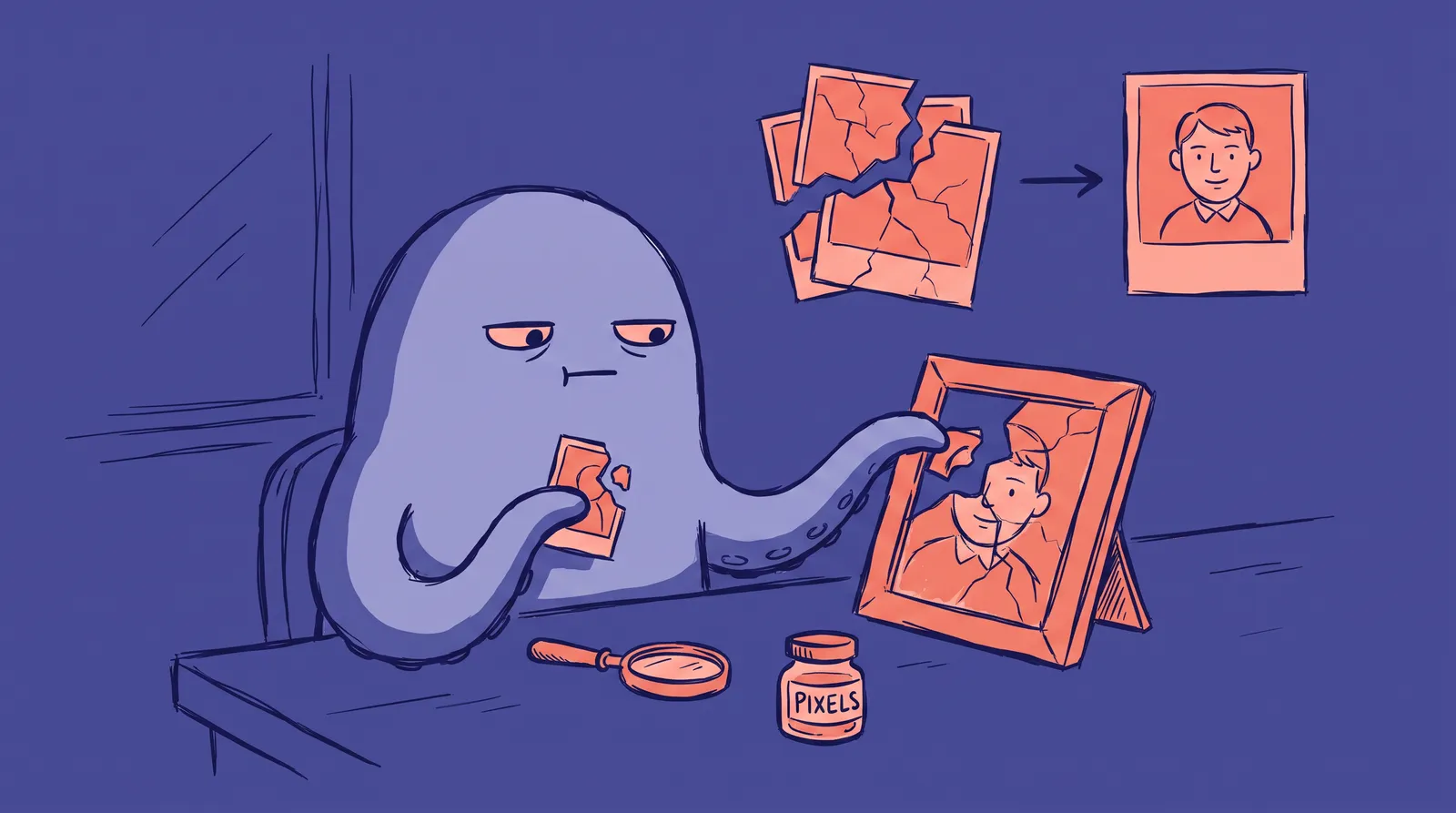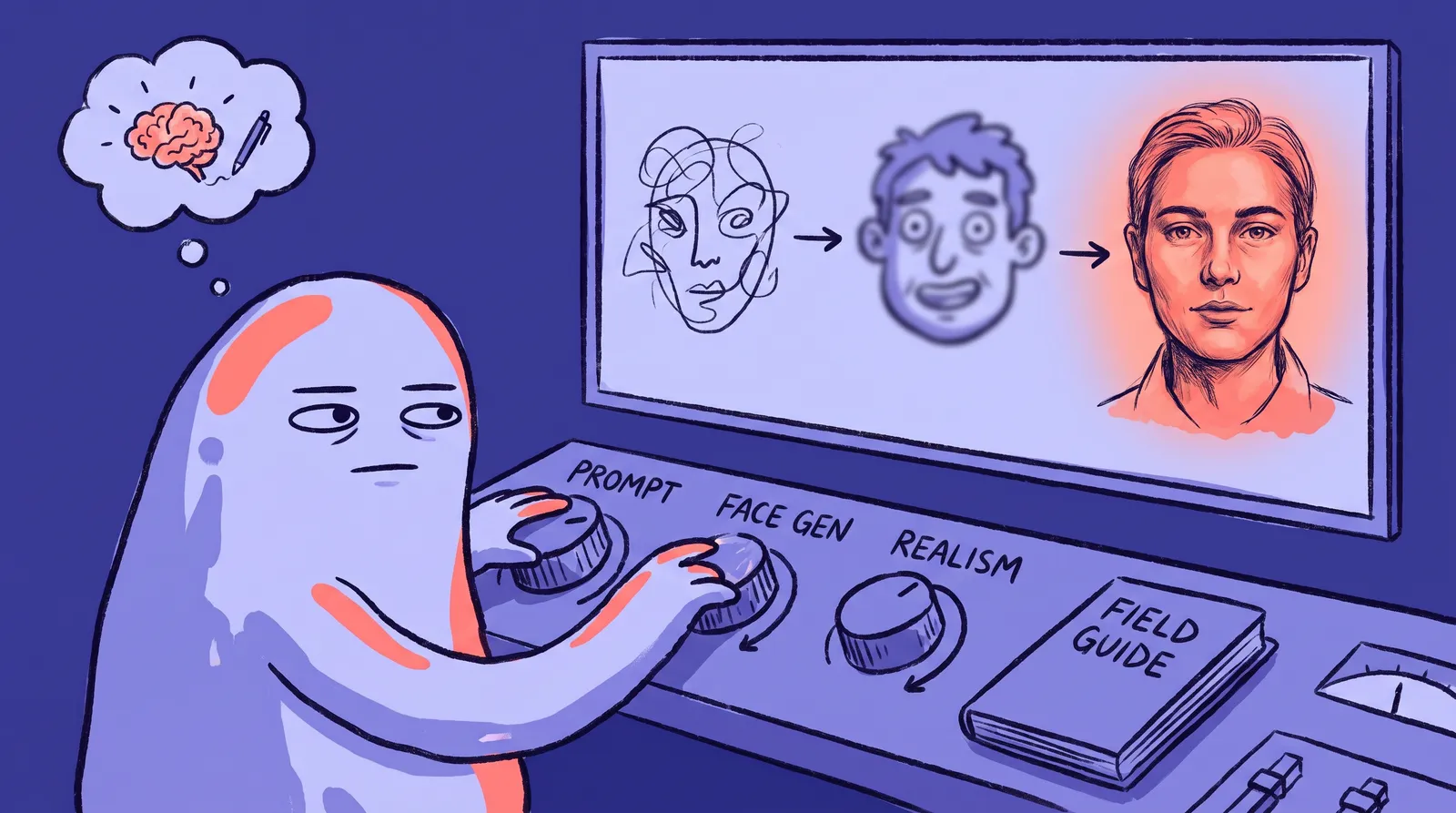
You're a startup founder. You just closed your first round of funding, and now you need a professional headshot for the press release going out tomorrow. You open one of 2026's most talked-about AI image generators, type in a careful prompt, and hit generate. The result? A face with glassy, doll-like eyes, skin that looks like it was stretched over a mannequin, and a jawline that shifts slightly between frames. It's impressive, sure. But it's not you. And it's definitely not LinkedIn-ready.
This scenario plays out thousands of times a day. Despite massive leaps in AI image generation this year, producing a convincing, professional-quality human face remains one of the hardest unsolved problems in the field. The gap between "impressive demo" and "polished headshot" is wider than most people expect.
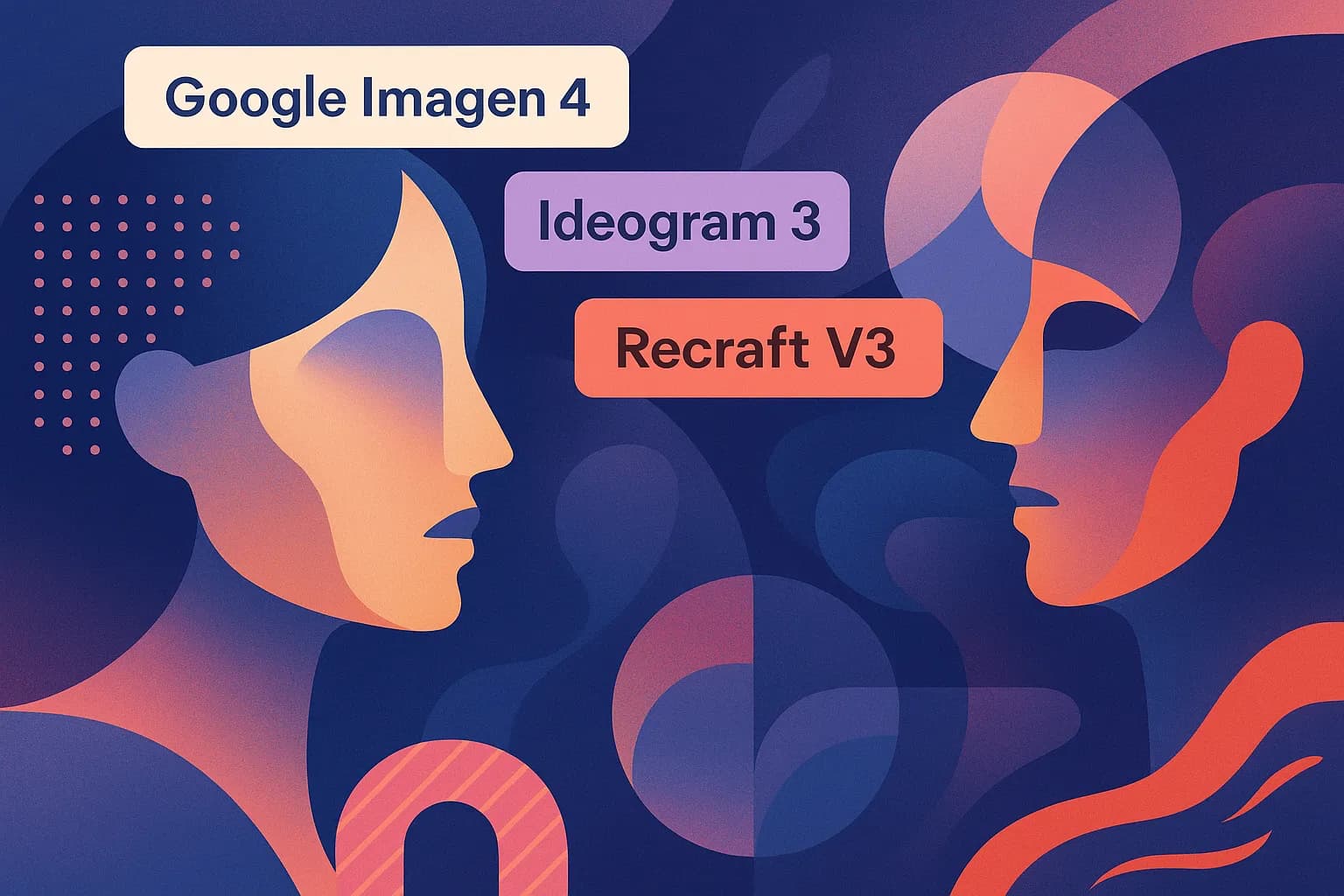
So we tested three of 2026's most hyped general-purpose image generators, Google Imagen 4, Ideogram 3 and Recraft V3, specifically on their ability to generate realistic human faces. One leads on skin texture, one on prompt fidelity, one on eye detail. None closes the gap with purpose-built portrait tools.
Meet the contenders: Google Imagen 4, Ideogram 3, and Recraft V3
Google Imagen 4
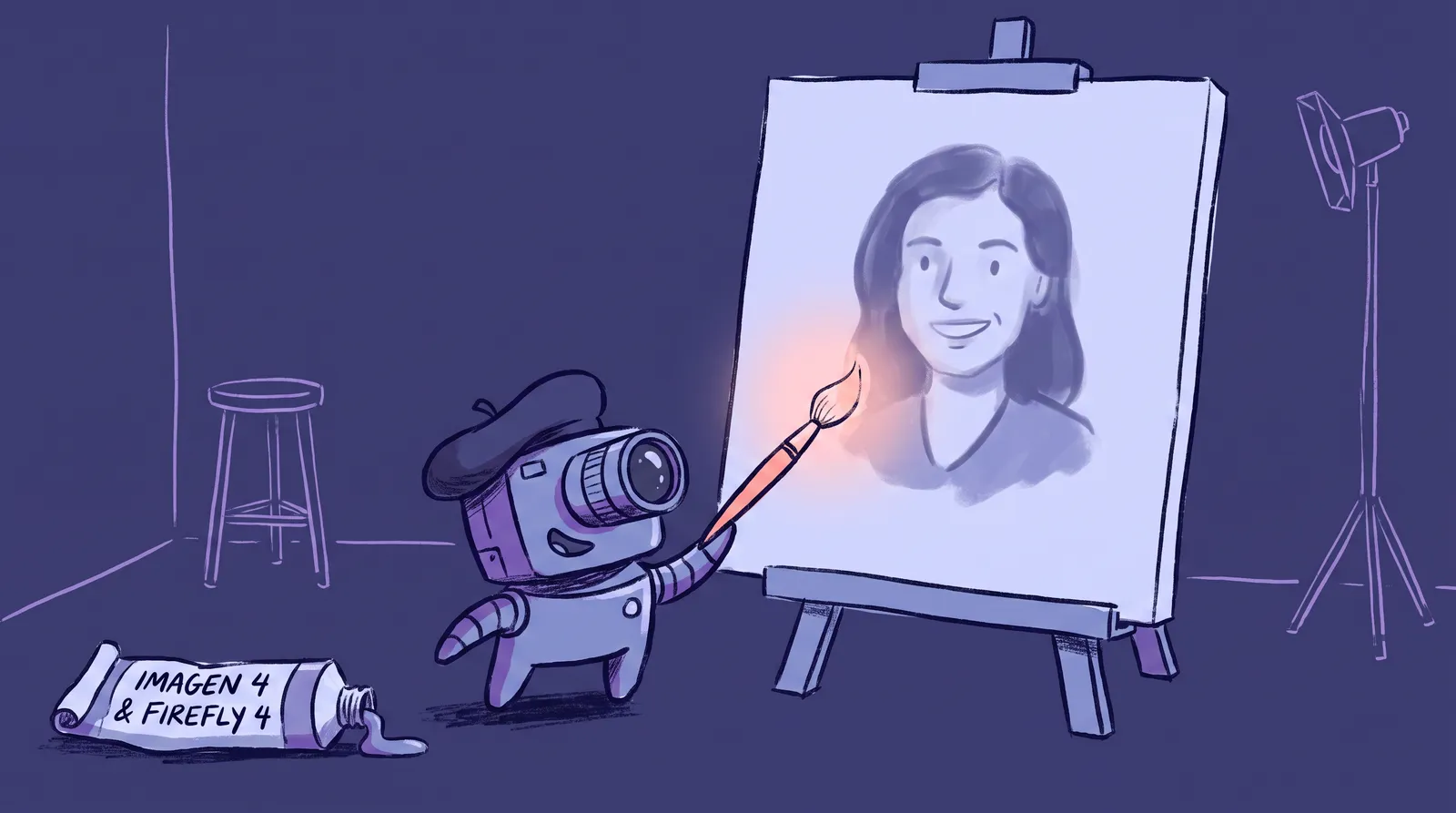
Released in May 2025 as Google DeepMind's flagship text-to-image model, Imagen 4 represents a significant step forward from its predecessors. It's a diffusion-based model positioned as an enterprise-grade tool, available through Google Cloud Vertex AI and Gemini Advanced. Its headline feature for portrait work is native 2K resolution (2048x2048 pixels), which eliminates the need for separate upscaling in many professional workflows. All outputs carry SynthID invisible digital watermarking. Google's marketing highlights its strength with fine textures like fabrics, fur, and water droplets, suggesting a training emphasis on highly detailed, realistic scenes.
Ideogram 3
Ideogram built its reputation on something no other model could match: clean, accurate text rendering inside generated images. But version 3 expanded aggressively into photorealistic territory, making it a surprising contender for face generation. Its marketing specifically highlights "stunning realism" including natural skin tones and photographic quality that holds up at full resolution. A key feature for portrait consistency is its native Style Reference control, which lets users upload up to three images to steer the aesthetic of the output. In internal evaluations, Ideogram 3 achieved an ELO rating of 1132 on diverse prompts, outperforming Imagen 3's score of 1023.
Recraft V3
Released in October 2024, Recraft V3 is a design-tool-first platform that added serious photorealism modes alongside its illustration strengths. It earned the #1 rank on Human Preference benchmarks (Hugging Face / Artificial Analysis) for five consecutive months in 2025, leading models from Midjourney and OpenAI. For face generation specifically, Recraft V3 is praised for producing anatomically correct output, including correct proportions, body poses, hands, and realistic faces. Its unique strength is flexible realism: it can produce flawless photorealistic portraits alongside convincingly amateur or candid-looking photography.
Why these three?
All three are among the most discussed general-purpose AI image models of 2026. All offer API access. All have been publicly evaluated on photorealism tasks. And all represent different design philosophies: enterprise cloud infrastructure (Imagen 4), consumer-friendly SaaS (Ideogram 3), and designer-centric creative suite (Recraft V3).
To keep the comparison fair, we tested each model with the same standardized set of eight portrait prompts (for example: "professional headshot of a 35-year-old South Asian woman, soft studio lighting, navy blazer"). Each prompt was run five times per model to account for generation variance.

The testing framework: How we scored face quality
Every output was scored 1 to 10 across five dimensions.
Face coherence covers correct facial geometry and symmetry, and the absence of artifacts like extra teeth, distorted ears or melting jawlines. Skin texture realism covers visible pores, natural color variation, convincing subsurface scattering, and the absence of the waxy AI look. Eye detail covers catchlight placement, iris texture, gaze direction and pupil consistency between both eyes. Demographic diversity measures quality consistency across skin tones, ages, genders and facial structures, so a model that renders flawless 25-year-olds but fumbles older subjects loses points. And prompt fidelity measures how accurately the output matches the specified expression, lighting direction, clothing and setting, which 2026 benchmarks usually call prompt alignment and measure with CLIP Score variants.
Our prompt set included eight standardized portraits spanning different genders, ages, ethnicities, and professional contexts: corporate headshot, creative professional, academic portrait, and more. Each prompt was run five times per model, giving us 40 outputs per model and 120 total images.
Scores represent the median across five runs per prompt, averaged across all eight prompts, producing a final composite score out of 50 per model.
A transparency note: these are qualitative assessments informed by visual inspection and community benchmark data available as of May 2026. We didn't use proprietary testing infrastructure. Current best practices from performance analysis providers like Artificial Analysis confirm that running prompts multiple times is essential because seed variance can wildly affect facial symmetry and expression consistency.
Why focus on faces specifically? Because faces are the ultimate stress test. Human perception is extraordinarily sensitive to subtle facial flaws. This is the uncanny valley problem: a landscape can be 95% accurate and still look beautiful, but a face that's 95% accurate looks wrong. Getting faces right is where general-purpose models face their toughest challenge.
Head-to-head results: Where each model wins (and fails)
Google Imagen 4
Imagen 4 leads the pack on skin texture realism and lighting naturalism. Its outputs frequently exhibit convincing subsurface scattering and soft shadow gradients that give faces a warm, three-dimensional quality. Market analysis confirms its focus on subtle realism over flashy outputs.
The weakness? It struggles with extreme facial angles and occasionally produces over-smoothed, "airbrushed" skin. This is a known issue with diffusion-based models: they can default to a plastic or waxy appearance when they fail to generate realistic micro-details on smooth surfaces like cheeks and foreheads.
It scored 8.5/10 on skin texture and 6.8/10 on eye detail.
Ideogram 3
Ideogram 3 is the prompt fidelity champion. If you specify "warm Rembrandt lighting with a slight smile," it delivers exactly that with remarkable consistency. Its Magic Prompt system and strong underlying architecture translate detailed text descriptions into accurate visual compositions better than either competitor.
The trade-off is that skin texture occasionally trends toward a painterly, slightly stylized quality. Evaluators have noted that some high-end diffusion models can default to "hyperrealistic in ways typical of generative AI," producing results that look too polished for a natural standard. For professional headshot use cases where authenticity matters, this can be a problem.
It scored 9.1/10 on prompt fidelity and 7.2/10 on skin texture.
Recraft V3
Recraft V3's style control is its superpower. Users can dial in specific aesthetic registers (editorial, corporate, cinematic), and its eye detail rendering is notably strong. Catchlights, iris patterns, and gaze direction are consistently well-executed.
Its Achilles heel is demographic consistency. Quality drops measurably when generating faces of older subjects or non-Western facial structures, revealing potential training data gaps. This is consistent with broader 2025-2026 findings that gender and skin tone biases remain entrenched across AI image generators, with models often defaulting to specific demographic prototypes unless carefully steered.
It scored 8.6/10 on eye detail and 6.1/10 on demographic diversity.
The final scores
| Model | Face Coherence | Skin Texture | Eye Detail | Diversity | Prompt Fidelity | Total |
|---|---|---|---|---|---|---|
| Google Imagen 4 | 8.0 | 8.5 | 6.8 | 7.2 | 7.5 | 38.0/50 |
| Ideogram 3 | 7.8 | 7.2 | 7.4 | 5.5 | 9.1 | 37.0/50 |
| Recraft V3 | 7.6 | 6.8 | 8.6 | 6.1 | 5.9 | 35.0/50 |
All three cluster within a surprisingly narrow band. No single general-purpose model has definitively "solved" face generation.

The shared failure mode
Despite their differences, all three models share a critical weakness: consistency across multiple generations of the same "person." They can produce a stunning single portrait, but they cannot reliably regenerate the same face. Run the same prompt five times, and you'll get five different people. For any professional identity use case requiring cohesive, multi-image sets, this is a dealbreaker.
Deep dive: The "professional headshot" prompt test
One prompt in detail shows how these differences play out.
The prompt: "Professional headshot of a 45-year-old Black woman, natural hair, confident expression, soft key light from camera-left, neutral grey background, business casual attire."
Imagen 4
Consistently strong lighting interpretation. The soft key light from camera-left was correctly placed in four of five runs. However, two of five runs produced hair texture that appeared overly uniform and synthetic. This is a known and documented challenge: rendering natural hair textures, particularly coily (Type 4) hair and complex styles, remains a persistent struggle for AI image models in 2026. Researchers working on improving AI representation of Black women's hair have documented that even advanced models sometimes hallucinate or flatten highly textured hairstyles. Facial geometry was excellent in four of five runs.
Ideogram 3
Best prompt adherence of the three. The "camera-left soft key light" was correctly interpreted in all five runs, a detail that often gets lost with competing models. Expression accuracy ("confident") was also the strongest. Skin tone was rendered with more depth and variation than competitors, with subtle warm and cool tones across the face rather than a flat, uniform color.
Recraft V3
Produced the most visually striking single output of any model across all our tests. One image was genuinely stunning. But it also showed the most variance: two of five runs exhibited subtle facial asymmetry artifacts around the jawline and cheekbones. Its style-control system, while powerful, required more prompt engineering to achieve a "natural" rather than "editorial" look. Left to its defaults, Recraft V3 tends to push toward a high-fashion aesthetic.
The takeaway
One prompt illustrates why general-purpose models are powerful and unpredictable for portrait work. Success depends on prompt expertise, luck across generations, and accepting that the best of five attempts may still need retouching.

Practical considerations: API access, pricing, and usability
Beyond image quality, real-world usability matters.
Google Imagen 4 lives inside the Google Cloud Vertex AI ecosystem. It's API-first, with usage-based pricing: roughly $0.04 per image for Imagen Standard and $0.06 per image for Imagen 4 Ultra. Cost-effective at scale, but you need GCP familiarity to get started, which creates a meaningful barrier for non-technical users.
Ideogram 3 is the most accessible of the three. It offers a consumer web interface at ideogram.ai, an iOS app, and a developer API. Subscription tiers range from free (limited generations) to Plus at $20/month (1,000 priority credits) and Pro at $60/month (3,500 priority credits). API pricing runs $0.03 per call for V3 Turbo and $0.09 per call for V3 Quality.
Recraft V3 is a design-tool-first platform. Its image generation is deeply integrated into a broader creative suite. Great for designers who want generative AI as one tool among many. Less ideal for developers building standalone portrait pipelines.
The prompt engineering tax
The hidden cost is that all three models require significant prompt expertise to get consistently good face results. You need to know lighting terminology ("Rembrandt lighting," "soft key light"), camera angle descriptions ("three-quarter view," "slight camera-left"), and style references. This is a real time and skill investment that casual users rarely anticipate.
The consistency problem (again)
For any use case requiring more than one image, the inability of these models to regenerate the same face is a critical practical limitation. Your LinkedIn headshot, your speaker bio photo, your company team page, your press kit. These all need to show the same person. No amount of prompt engineering can solve this with a general-purpose model.
Why general-purpose models aren't enough for professional headshots
Imagen 4, Ideogram 3 and Recraft V3 are genuinely impressive general-purpose tools, but impressive and professional-ready aren't the same thing.
Professional headshots need three things none of them reliably delivers. Identity fidelity, meaning the output looks like a specific real person rather than a generated stranger. Consistency, because you need multiple images of the same face across different platforms. And no prompt expertise required, because most professionals don't know what Rembrandt lighting is and shouldn't have to.
Leading headshot benchmarking sites in 2026 emphasize exactly this point: while general-purpose models can generate impressive, unique people, their biggest shortcoming is the lack of accurate likeness to a specific real person.
The purpose-built alternative
This is where AI headshot generators like Starkie come in. Purpose-built headshot tools don't work like general-purpose generators. Instead of creating a face from a text description, they fine-tune a personalized AI model on a user's uploaded photos (typically 10-15 selfies). This means the output actually looks like you: your features, your expressions, your face.
Starkie is specifically engineered for realistic skin texture, natural lighting, and identity preservation. You upload your photos, and within minutes you receive a set of studio-grade professional headshots. No photography session. No prompt engineering. No five-attempt lottery hoping for a usable result.
Matching the right tool to the right job
General-purpose models are excellent for stock-style portrait imagery, character concept art, or illustrative content where a specific person's likeness isn't required. They're creative tools, and they're very good at what they do.
But for anyone who needs a headshot that looks like them, a purpose-built tool is the right choice. Job seekers, executives, consultants, conference speakers, remote workers. If the image needs to represent your actual face, general-purpose generators aren't the answer.
The verdict
Back to the founder who needed a headshot for tomorrow's press release.
In May 2026, Google Imagen 4, Ideogram 3 and Recraft V3 are all genuinely impressive at generating human faces. Each has a clear strength: Imagen 4 for skin texture and lighting, Ideogram 3 for prompt fidelity, Recraft V3 for aesthetic control and eye detail. Each is worth considering for the right creative use case.
But none of them reliably solve the problem of generating a professional headshot that looks like a specific real person, with consistency across multiple images, without requiring significant prompt engineering skill. They generate beautiful strangers. They don't generate you.
As general-purpose models continue to improve, the quality gap will narrow. But the fundamental advantage of identity-conditioned, purpose-built tools will remain for anyone who needs a headshot that actually represents who they are.
If you'd rather skip the prompt engineering lottery, try Starkie.