Sixty six percent of photographers in the United States are self-employed, according to the Bureau of Labor Statistics. Most of them are running a small business with $10,000 or more of gear in a camera bag, and a surprising number believe their homeowners policy has them covered. It usually does not, and the gap only shows up the day a claim gets denied.
Why your homeowners policy will not pay out on a paid shoot
Standard homeowners and renters policies are written for personal property, not business equipment. The moment you accept payment for a shoot, whether it is a wedding, a corporate headshot day, or a single paid portrait session, the gear you used to earn that income falls under a business-use exclusion that most policies carry. Suncoast Insurance puts it plainly: if the same camera is stolen during a paid wedding shoot instead of a family vacation, the claim can be denied outright.
Even when a homeowners policy does pay out, the payout is thin. Many carriers cap electronics or camera gear at $1,000 to $2,500 per item, according to the same source, which does not come close to replacing a professional camera body and lens. A personal articles floater can raise that limit for a hobbyist, but it still will not cover equipment used commercially. Once you are being paid, you need a business policy built for photography, not a rider bolted onto a homeowners plan.
What insurance do working photographers actually need?
Photography insurance is not one product. Insureon breaks it into a handful of distinct coverages that solve different problems:
- General liability covers third-party injury or property damage during a shoot, like a light stand tipping onto a guest or a client tripping over a bag. Commercial landlords and venues often require it before you can set foot on their property.
- Commercial property or inland marine coverage protects the gear itself, whether it sits in your studio or travels with you to a client's office. Inland marine is the piece that matters most for photographers, since it follows the equipment rather than staying tied to one address.
- Professional liability, also called errors and omissions, protects you if a client claims you failed to deliver what you promised, whether that is a missed shot list, a corrupted file, or a shoot that ran short.
- Commercial auto covers accidents that happen while you are driving to or from a paid job, which your personal auto policy typically excludes.
Bundling the first two into a Business Owners Policy is usually cheaper than buying them separately, and it is the starting point most carriers recommend for a solo photographer. If you bring on a second shooter or an assistant for a large corporate headshot day, most states also require workers' compensation the moment that person counts as an employee rather than a contractor, which is easy to overlook during the same growth curve that takes a solo photographer into a studio brand with a small crew.

What does photography insurance not cover?
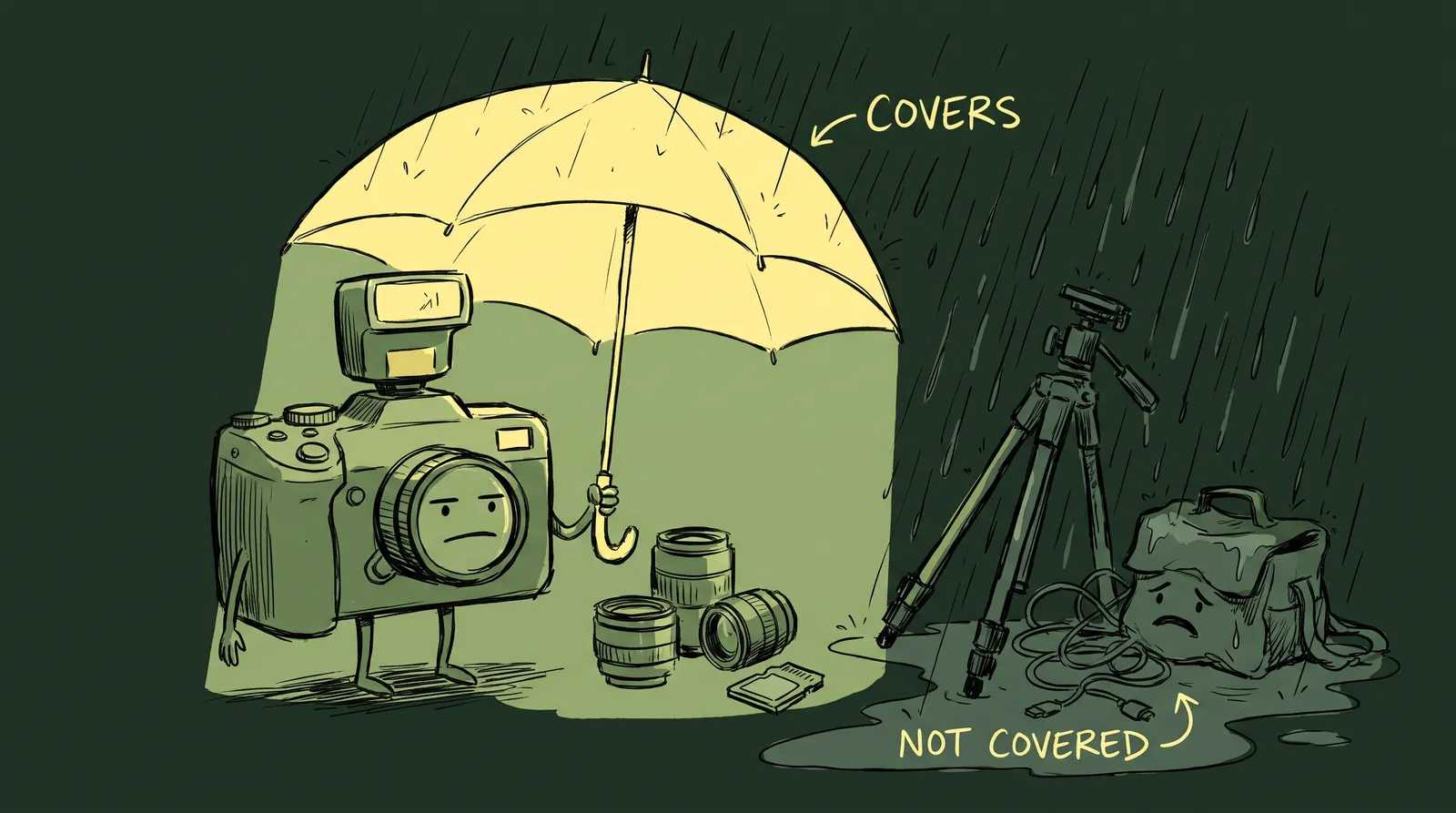
The exclusions are where photographers get caught off guard, and one in particular accounts for a large share of denied claims: gear stolen from a vehicle.
Mads Peter Iversen, a photographer based in Aarhus, Denmark, found this out on a trip through Lithuania in 2016. Thieves broke into his locked rental car and took roughly $4,500 worth of gear, including his Canon 5D Mark III and a Tamron 24-70mm f/2.8 lens, along with several travel companions' backpacks. His insurer, Tryg, refused the claim because the thieves had used an electronic method to open the trunk without leaving a mark. As Iversen told PetaPixel, the policy only covered theft from a car if there was visible damage proving forced entry, and a clean electronic break-in did not qualify. The rental company declined too, since its coverage only applied if the entire vehicle was taken.
That same rule shows up across the industry. Insurers generally will not pay for equipment stolen from an unattended vehicle unless there is proof of a break-in, such as broken glass or pry marks around the lock, precisely because leaving gear in a car is treated as an avoidable risk. If you are shooting an on-location corporate headshot day and step away from your car between setups, that camera bag on the back seat is largely on its own.
Other common gaps: mechanical breakdown and ordinary wear and tear are almost never covered, since insurance pays for sudden loss, not equipment simply wearing out. Depreciated market value, rather than full replacement cost, is what some cheaper policies pay on an older camera body. And a policy bought for a home studio may cap or exclude coverage once gear leaves the premises, which matters if most of your income now comes from on-location sessions rather than studio bookings.
How much does photography insurance cost in 2026?
Coverage is not expensive relative to the gear it protects. MoneyGeek's 2026 data puts general liability for arts, media, and entertainment businesses, the closest category to photography, at around $38 a month, with professional liability close behind at $39 a month and commercial property coverage around $24 a month. That is well under the $123, $56, and $221 a month those same three coverages average across small businesses generally, since a one-person photography operation carries less risk than a business with staff, a storefront, or heavier equipment.
Equipment coverage through a photography association is often the cheapest entry point. Members of the Professional Photographers of America get up to $15,000 in equipment coverage bundled into membership, with a $50 flat deductible for repairs and $350 for a full replacement, and higher tiers extend coverage to $100,000 including drones. PPA's general liability option is similarly bundled rather than sold as a standalone add-on, which is worth checking before shopping a standalone policy from scratch. Treat the premium as a fixed cost of doing business, the same way you would any other line item in a business model built around AI-assisted workflows, and it stops feeling optional.
Your actual premium depends on your revenue, the value of your kit, whether you shoot on location or in a fixed studio, and your state. A photographer doing ten paid shoots a year will pay less than one running a full-time studio with employees and a van full of lighting gear.
For photographers who only take on a handful of corporate headshot days a year, an annual policy is not always the best fit. Carriers like Thimble sell general liability by the hour, day, week, or month rather than only as a yearly plan, which suits someone booking a single office headshot day rather than shooting weddings every weekend. At around ten paid events a year, that pay-per-shoot approach can run $400 to $600 total, against $600 to $1,200 for an annual policy covering the same volume, so it is worth pricing both before defaulting to a yearly plan.

What is a certificate of insurance, and when do you need one?
A certificate of insurance is proof that your liability policy exists, and most commercial buildings will not let you shoot on the property without one. Office managers, building management companies, and event venues request them as standard practice before a corporate headshot day, a session some photographers now pair with AI retouching tools to upsell clients rather than compete with them. $1 million per occurrence is the default figure written into most venue packets and vendor agreements. Larger corporate clients sometimes ask for more and may require both the building and the client company to be named as additional insured on the policy, which grants them actual rights under it rather than just a piece of paper confirming it exists.
The certificate itself costs nothing and most carriers can issue one within minutes once you already hold the underlying policy. What takes time is having the liability coverage in place before the request lands in your inbox a week before the shoot. Photographers who wait until a building's facilities team asks for a COI often find themselves buying a policy under deadline pressure instead of shopping around.
How do you file a photography equipment insurance claim?
When gear is stolen or damaged, Full Frame Insurance recommends filing a police report first for any theft, since a claim without one is likely to be denied outright. From there, most carriers want your policy number, the date, time, and location of the incident, a description of what happened, an estimated dollar value of the loss, and photos of any damage. Processing a claim typically takes three to five weeks depending on how complete your documentation is, with an adjuster usually making contact within five to ten business days of filing.
Keeping serial numbers and receipts for your gear on file, separate from the bag it usually lives in, turns that documentation step from a scramble into a five-minute task. It also gives you a straight answer when a client asks what happens if something goes wrong mid-shoot, instead of a vague reassurance that you will figure it out.
A pre-shoot insurance checklist
Before booking a session that involves someone else's property, whether that is a corporate office, a rented studio, or a client's home:
- Confirm your general liability policy covers the venue type and ask whether they require additional insured status.
- Check that your equipment coverage follows gear off-premises, not just inside a studio you own.
- Keep a digital list of serial numbers and purchase dates for everything in your bag.
- Never leave equipment visible in a parked car between setups, since most policies will not pay out if it is stolen there.
- Request your certificate of insurance at least a week before any shoot that requires one, so a slow turnaround does not put the booking at risk.
None of this replaces good judgment on set, but it is the difference between a stolen lens being a bad afternoon and a stolen lens being a bad quarter. Companies that skip the in-person photographer entirely and generate employee headshots with a tool like Starkie AI do not carry this particular risk, but for the freelance and studio photographers still booking on-location corporate work, insurance is as much a part of running the business as pricing your sessions correctly.
Running a photography business, like running any small business, means carrying the risk the client cannot see. The gear in your bag is the easy part to protect. The harder part is knowing which policy actually pays out when something goes wrong, and that only comes from reading the exclusions before you need them, not after.