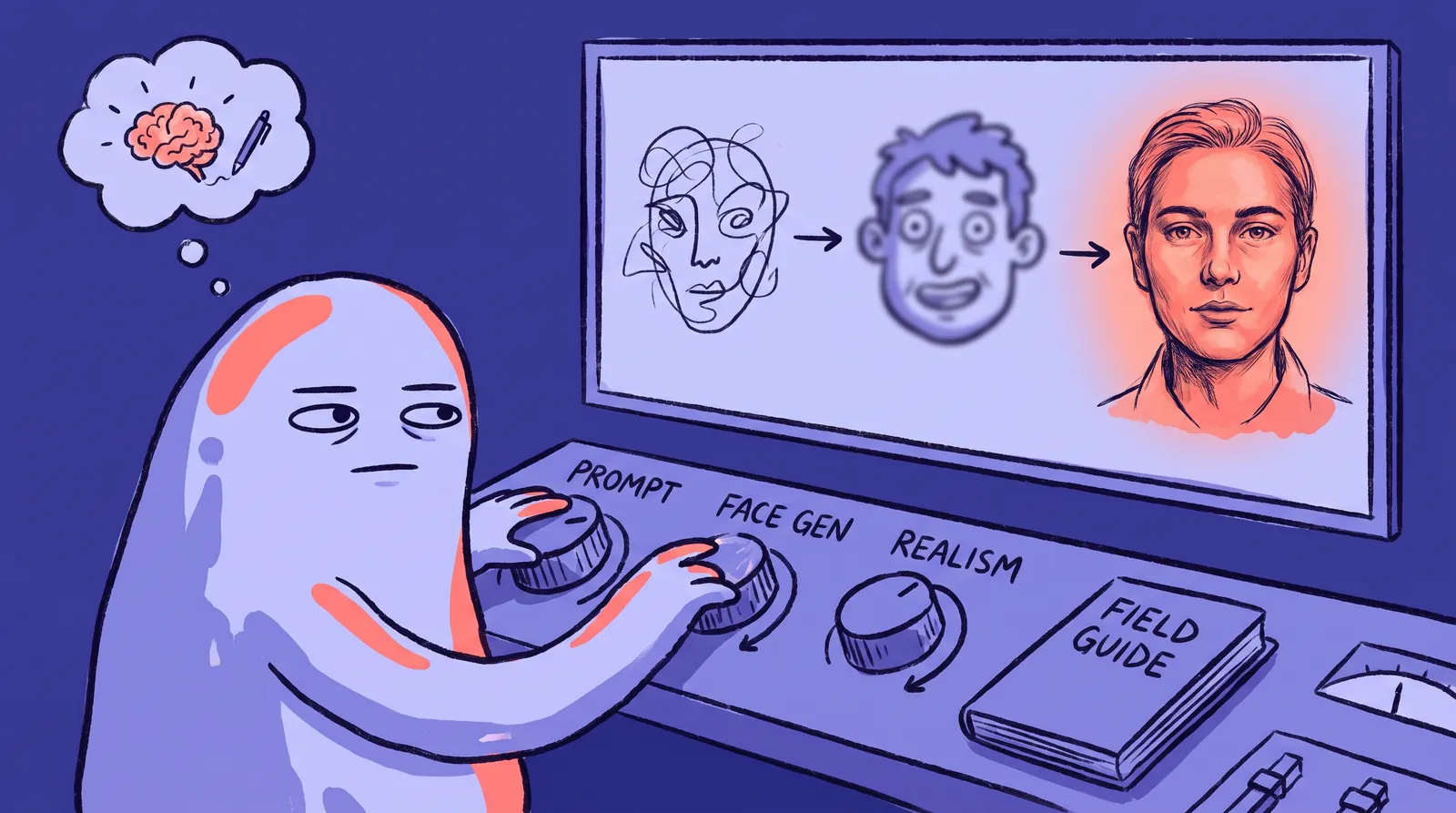
You upload 10 selfies. Five minutes later, you're looking at a studio-quality headshot of yourself in a setting you've never visited, wearing clothes you've never owned. The likeness is uncanny. But how does the AI actually learn your face, not just any face, from a handful of photos?
Modern AI image generators like Starkie AI don't just produce generic portraits. They learn the unique geometry of your cheekbones, the precise color of your eyes, the way your smile creases. The answer is fine-tuning, and three techniques dominate it in 2025 and 2026: LoRA, DreamBooth and Textual Inversion.
If you've read our piece on how diffusion models generate AI faces, you know how the engine works. This is the steering wheel: how that engine gets pointed at you specifically.
A 30-second primer: What does "fine-tuning" actually mean?
Fine-tuning means taking a massive pre-trained model, one trained on billions of images, and teaching it something new and specific without retraining the whole thing from scratch. Base models like Stable Diffusion or FLUX were trained on datasets like LAION-5B (5.85 billion CLIP-filtered images), requiring months of compute time and millions of dollars. Fine-tuning is how you piggyback on all that knowledge cheaply.
Think of a fine-tuned model as a world-class portrait painter who has studied millions of faces. Fine-tuning is showing that painter a few reference photos of you and saying, "Now paint this person." The painter doesn't forget how to paint. They just add you to their mental library.
Why is this necessary? Base models know what "a professional headshot" looks like in general. They understand lighting, composition, skin texture, and facial structure. But they have zero concept of your individual identity. Fine-tuning bridges that gap, and as Nomtek explains, it's a form of transfer learning where general knowledge gets redirected toward a specific task.
Three techniques answer the same question, how to teach the model a new concept, in fundamentally different ways. Textual Inversion teaches the model a new word. DreamBooth rewrites the model's memory. LoRA gives the model a set of portable, personalized stencils.

Textual inversion: Teaching the model a new word
Textual Inversion, introduced in the 2022 paper "An Image is Worth One Word", takes an elegant and minimalist approach. It doesn't change the model's "brain" (its weights) at all. Instead, it finds a new embedding, essentially a new word in the model's vocabulary, that points to the concept of your face.
When the model later encounters this custom token (say, <my_face>), it generates images of you. The model itself remains completely frozen.
Think of it this way: you can't add new paint colors to the painter's palette, but you can add a new word to their instruction manual. You find the perfect combination of existing descriptors ("angular jaw + hazel eyes + slight widow's peak + warm undertone") and assign it a shorthand label. The painter reads that label and knows exactly what to do.
The strengths are real. Textual Inversion outputs are tiny, typically 10KB to 100KB. Training is fast. And because no model weights are modified, there's zero risk of degrading the base model's general capabilities. The original research demonstrated successful personalization with only 3 to 5 images of a unique concept.
There's a fidelity ceiling, though. Because the model's weights stay frozen, Textual Inversion can only express your likeness through existing combinations in the embedding space. It captures general resemblance and style well but often struggles with fine-grained identity details: the exact curve of a nose, the specific asymmetry of a smile. As Graydient AI notes, LoRAs are better suited for training people's faces because they allow deeper model adaptation.
In practice, Textual Inversion remains useful for learning styles (e.g., "generate in the style of this artist"), but for photorealistic personalization like AI headshots, it's been largely superseded by more powerful methods.
DreamBooth: Rewriting the model's memory
Unlike Textual Inversion, DreamBooth actually updates the model's weights. Developed by researchers at Google, it fine-tunes the entire diffusion model (or large portions of it) so that a rare token identifier (like "sks person") becomes deeply associated with your specific appearance.
This time, you're not just adding a word to the painter's vocabulary. You're retraining the painter's muscle memory so that when they hear "sks person," their hands instinctively reproduce your exact features.
The key innovation is prior preservation loss, a trick DreamBooth uses to avoid "catastrophic forgetting," where the model overwrites its general knowledge while learning your face. During training, it generates its own reference images of the broader class ("a person") and uses them as an anchor. This teaches the model: "'sks person' means this exact face, while 'person' still means all people." As JustModels.ai warns, skipping this regularization step leads to a model that can only generate your training subject, not novel compositions.
The fidelity is impressive. Because DreamBooth modifies the model at a deeper level, it captures subtle, person-specific details that Textual Inversion misses. This is why early AI avatar apps in 2022 and 2023 gravitated toward it.
The costs are equally real. Training modifies millions or billions of parameters and produces a full model checkpoint, typically 2GB to 7GB depending on architecture. Training takes 30 to 60+ minutes on consumer GPUs and demands 16GB to 24GB+ of VRAM. Overfitting is a constant risk: too many training steps and the model produces only exact replicas of your input photos rather than fresh compositions. For best results, community consensus suggests 10 to 15 diverse, high-resolution input images.
For a single user doing personal experimentation, DreamBooth is powerful. For a production service handling thousands of users simultaneously? The math doesn't add up.
LoRA: The best of both worlds
LoRA (Low-Rank Adaptation) is a mathematical shortcut that changed the economics of personalization. Originally developed by Microsoft Research, it can reduce the number of trainable parameters by a factor of 10,000 and the GPU memory requirement by a factor of 3 compared to full fine-tuning.
Here's the core idea. Instead of updating all the model's weights (like DreamBooth), LoRA decomposes the weight updates into two small matrices, a low-rank factorization, that capture most of the important changes with a fraction of the parameters. These updates focus primarily on the model's cross-attention layers, the critical juncture where image and text information meet, making it the most efficient place to insert new concept data.
If DreamBooth is retraining the painter's entire muscle memory, LoRA is like giving the painter a small set of personalized stencils. The painter's core skills stay intact, but the stencils guide specific details of your face. The stencils are tiny and portable. You can swap them in and out without retraining the painter.

LoRA dominates in 2026 for practical reasons. Adapters are typically 2MB to 300MB (compared to multiple GB for a full DreamBooth checkpoint). They train in 10 to 30 minutes on a modern cloud GPU like an NVIDIA H100. And they can be hot-swapped at inference time, meaning a single base model can serve millions of users by simply loading different adapters. Production services can train a high-quality LoRA on an H100 for well under $5.
There's a useful technical nuance here. The "rank" in LoRA controls the trade-off between adapter size and expressiveness. A rank-4 LoRA is extremely compact but may miss subtle identity details. A rank-64 or rank-128 LoRA is larger but approaches DreamBooth-level fidelity. Production systems tune this parameter carefully based on their quality requirements.
The ecosystem around LoRA is deep. Platforms like Civitai have become major hubs for sharing LoRA adapters, while tools like Kohya_ss provide open-source training GUIs. Variants like QLoRA (Quantized LoRA) enable training on lower-memory consumer GPUs by quantizing the base model to 4-bit precision. And newer approaches like LyCORIS and LoHa approximate weight changes with even more parameter-efficient structures.
This is the approach, or family of approaches, that makes services like Starkie AI practically viable: the ability to learn your face from a small set of photos, generate high-fidelity headshots, and do so at scale without storing a multi-gigabyte model for every user.
Head-to-head: Comparing the three techniques
Here's how the three approaches stack up across the dimensions that matter most:
| Dimension | Textual Inversion | DreamBooth | LoRA (2026 Production) |
|---|---|---|---|
| What's Trained | Text embedding only | All model weights (U-Net) | Small adapter matrices |
| Identity Fidelity | Moderate (faces are hard) | Very high (sometimes too high) | Excellent (industry standard) |
| Output File Size | 10KB to 100KB | 2GB to 7GB+ | 2MB to 300MB |
| Training Time | ~30 min to 1 hour | ~30 min to 1 hour+ | 10 to 30 min (cloud H100) |
| VRAM Required | Low (~6-8GB) | Very high (~16-24GB+) | Medium (~8-12GB with QLoRA) |
| Typical Images Needed | 3 to 5+ | 10 to 15+ | 10 to 20+ |
| Key Limitation | Limited expressiveness | Huge file size; overfitting risk | Requires loading adapter with base model |
Why does the number of input photos vary? Textual Inversion can work with 3 to 5 images because it's only learning an embedding. DreamBooth historically needed 10 to 15+ diverse images to properly update weights without overfitting. LoRA sits in a similar range, often achieving strong results with 10 to 20 images depending on rank and training strategy.
Which one is best depends entirely on the use case. For personal experimentation and style transfer, Textual Inversion is quick and easy. For maximum fidelity in a research or single-user context, DreamBooth remains powerful. For production-scale personalized generation, LoRA has become the standard, and deservedly so.
One important note: modern systems often combine techniques. You might see LoRA fine-tuning paired with textual-inversion-style token conditioning, or DreamBooth training using LoRA as the parameter-efficient backend (sometimes called "DreamBooth + LoRA"). The lines between categories have blurred significantly by 2026.
From theory to your headshot: How Starkie AI puts it all together
The Starkie AI journey looks like this with the technical lens applied.
You upload a set of selfies and casual shots from your camera roll. The system preprocesses and curates them, with secondary models handling face detection, quality filtering to discard blurry or low-resolution images, and pose and lighting diversity checks. That step matters because, as GoCodeo puts it, garbage in, garbage out.
Then a personalized LoRA adapter is trained on your likeness: a compact set of weight adjustments that encode you. At inference time, that adapter loads alongside the base model, so one foundation model serves all users while your LoRA tells it who to generate.
The model then produces novel studio-quality headshots. Professional prompts guide composition, lighting and attire while your LoRA-defined identity shows up in every render.

Photo quality and diversity matter because these techniques learn from statistical patterns in your input images. If every photo is a front-facing selfie in the same lighting, the model learns a narrow version of you. It might nail that one angle but fall apart in a three-quarter view. Diverse angles, expressions, and lighting give the model a richer 3D understanding of your face. By 2026, production models are more resilient than ever, but community research consistently shows that curated datasets of diverse, high-quality images still outperform minimal photo sets for unmistakable likeness fidelity. That's exactly why Starkie AI's upload guidelines for the perfect source photo exist.
The speed story is worth highlighting too. Advances in LoRA training, including techniques like pivotal tuning and encoder-based initialization, have compressed personalization from hours to minutes across 2025 and 2026. This enables the near-instant experience users expect when they upload photos and receive polished headshots shortly after.
None of this is black-box sorcery. Personalized AI headshots come out of well-understood, mathematically grounded techniques applied with care.
Your selfies, decoded
Those 10 selfies you uploaded didn't just get fed into a generic algorithm. They were used to teach a world-class image generation model to recognize you, the precise geometry of your face, the character of your expressions, through one of the most elegant innovations in modern machine learning.
One sentence each: Textual Inversion teaches the model a new word, DreamBooth rewrites its memory, and LoRA gives it a set of portable, personalized stencils. Each trades fidelity against efficiency and scalability differently, and LoRA's balance of all three is why it underpins production personalization tools in 2026.
The techniques are still moving. Encoder-based personalization, single-image fine-tuning and multi-subject composition are all active research, and as they improve the gap between a casual selfie and a professional portrait keeps narrowing.
Try Starkie AI if you want to see what your own LoRA produces.