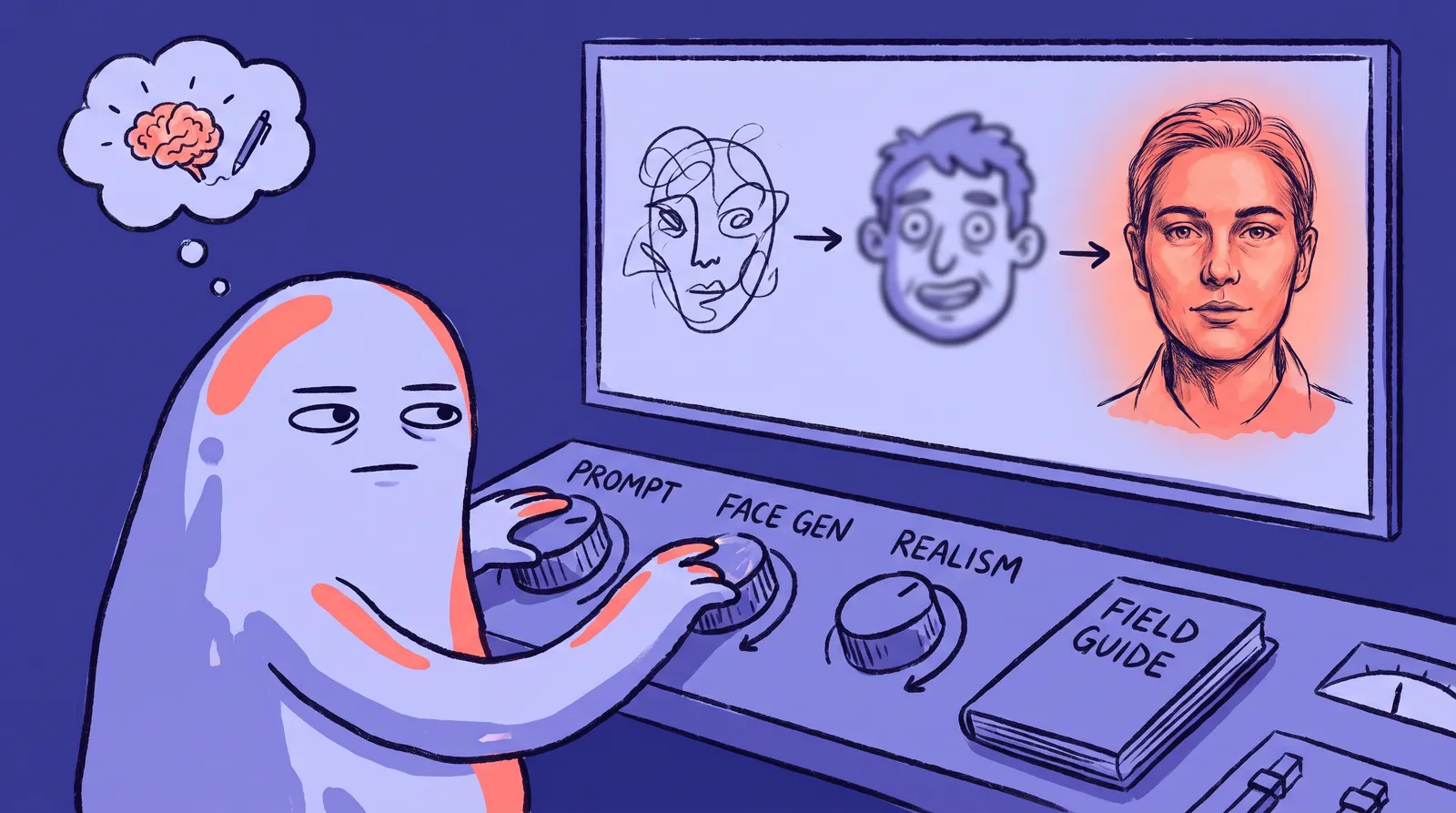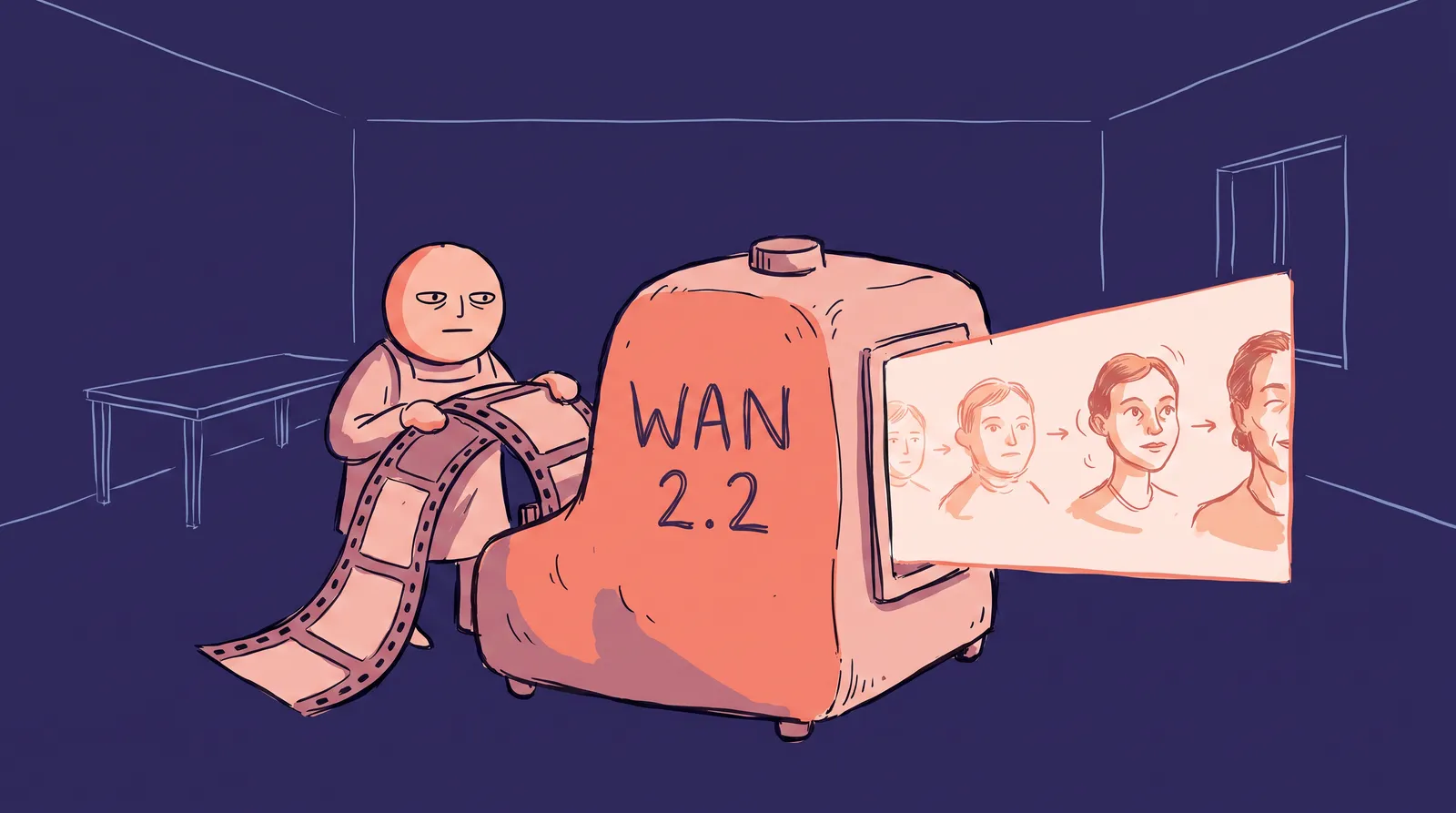
Look at two portrait-quality headshots side by side. One was generated by Flux 1.1 Pro, a leading image-only model built specifically for photorealistic stills. The other came from Wan 2.2, a video model that was never designed to produce headshots at all. Which one looks more like a real photograph?
If you picked the video model's output, you're not alone. And that result captures something genuinely strange happening in AI portrait generation right now. The most significant jump in headshot quality during 2026 didn't come from a better image generator. It came from a model trained to produce video, one that learned about human faces as a side effect of learning about motion, time, and physical consistency. This article breaks down why video-native AI models like Wan 2.2 are accidentally rewriting the rules of portrait generation. You'll get a technical explanation that actually makes sense, a structured comparison against the best image-only models, and a clear picture of what this means for AI headshot quality through the rest of 2026 and into 2027.
What makes a model 'video-native,' and why it matters
The term "video-native" describes AI models trained primarily on sequences of video frames rather than individual static images. Instead of learning what a single photograph looks like, these models learn what happens across time. They process motion, lighting shifts, and object permanence as continuous streams rather than isolated snapshots.
Wan 2.2, released by Alibaba, is the flagship open-source example in 2026. Its contemporaries include Kling 3.0 from Kuaishou, Veo 3.1 from Google DeepMind, and OpenAI's Sora 2. All share a common foundation: they were trained on massive video corpora and learned to maintain visual consistency across dozens or hundreds of frames.
The architectural difference from image-only models is fundamental. Models like Stable Diffusion 3.5 Large and Flux 1.1 Pro learn to reconstruct a single 2D image from noise. That's hard, but it's a bounded problem. Video-native models must solve a much harder version: reconstruct not just one convincing frame, but a sequence of frames where every element stays consistent. Shape, color, texture, lighting, and spatial relationships all need to hold together across time.

This is where things get interesting for portraits. Consider what happens when a video model generates a face that subtly shifts shape between frame 3 and frame 7. The nose drifts, the jawline warps, the eye spacing changes. In video, that looks immediately wrong. The model gets penalized during training and is forced to develop a more robust internal representation of facial geometry. Essentially, the model builds something close to a 3D understanding of faces, not because anyone told it to, but because video won't work without it.
There's also a data advantage. Video datasets contain millions of hours of footage showing human faces at every conceivable angle, under every lighting condition, with every expression. That's a far richer facial training curriculum than the curated static image datasets that image-only models rely on.
Wan 2.2 also uses a Mixture-of-Experts (MoE) architecture, which allows specialized sub-networks to handle different stages of the generation process. One "expert" might focus on scene structure while another refines fine details like skin texture. This modularity contributes to the model's surprisingly strong performance on static portrait tasks.
All of this temporal training pressure creates three specific technical capabilities that translate directly into better portrait quality. Let's look at each one.
The technical 'why': Temporal coherence, 3D-aware geometry, and optical flow
Three mechanisms, all developed to make video look convincing, turn out to be exactly what portrait generation needs.
Temporal coherence is the simplest to explain. The model learns that the nose in frame 1 and the nose in frame 60 must be the same nose. Not a similar nose. The same one. This forces the network to encode stable, identity-preserving facial geometry rather than generating texture patterns that look plausible in isolation but don't hold up to scrutiny. Temporal coherence is widely considered the hardest problem in AI video because it requires maintaining global consistency across an entire additional dimension: time. Newer models enforce it using techniques like 3D RoPE positional encoding, which helps objects maintain their shape in three-dimensional space.
3D-aware representations emerge because video models have to handle camera movement. When a face rotates from a three-quarter angle to a front-on view, the transition must follow real geometric rules. Ear placement, jaw shadow, eye spacing: any violation shows up as a visible glitch. The model learns to simulate a pseudo-3D understanding of faces without anyone explicitly teaching it 3D geometry. In blind tests during 2026, models like Veo 3.1 have demonstrated implicit handling of scene lighting and physical properties that suggest genuine 3D awareness, while Sora 2 has been cited for its strong physics and motion realism.
Optical flow supervision is the third piece. Optical flow tracks how individual pixels move between frames. This trains the model to understand surface continuity: skin texture doesn't teleport from one position to another, lighting gradients shift smoothly as surfaces curve, and hair strands maintain physical plausibility. When you extract a single frame from a model trained this way, the skin texture reads as real because it was generated by a system that understands surfaces, not just patterns.

Here's what these three capabilities produce in concrete portrait terms: fewer uncanny valley artifacts, more consistent ear and eye symmetry, and lighting that reads as physically plausible rather than artificially smoothed. The counterintuitive part? None of these capabilities were optimized for portrait photography. They were optimized for video realism. But human faces happen to be the hardest temporal consistency problem video models face, which means faces got the most training pressure and the most improvement.
Comparing Wan 2.2, Flux 1.1, and Stable Diffusion 3.5 on face generation
How do these theoretical advantages hold up in practice? Let's look at how Wan 2.2 compares to the leading image-only models on portrait-specific tasks, drawing from publicly available evaluations and community testing current to mid-2026.
The comparison covers five portrait-specific dimensions: facial symmetry accuracy, skin texture realism, lighting consistency, identity stability across different prompts, and artifact frequency (extra fingers near the face, malformed ears, eye asymmetry).
Wan 2.2's video-native training advantage shows up most clearly in three areas. Skin texture coherence benefits from optical flow supervision: Wan 2.2 produces micro-texture variation (pores, fine lines, subtle skin irregularities) that reads as photographed rather than rendered. Lighting gradient realism benefits from temporal consistency training: shadows and highlights follow real surface geometry instead of appearing as flat overlays. Identity stability across prompts benefits from the model's 3D-aware representations: the same face prompted in different contexts maintains more consistent proportions.
Image models still lead elsewhere. Flux 1.1 Pro keeps an edge in stylistic control and fine-tuning flexibility. If you need a specific aesthetic, a particular color grade, or tight creative direction, Flux gives you more precise levers to pull. Stable Diffusion 3.5 Large remains the most accessible model for community customization, with a vast ecosystem of LoRA fine-tunes and workflow integrations. The comparison isn't a knockout. It's contextual.
The two are converging. By mid-2026, blind tests show that recruiters and hiring managers struggle to distinguish high-quality AI headshots from traditional studio photographs, regardless of which leading model generated them. The basic "is it fake" test has been largely solved across all top-tier models. The differences now show up in subtler dimensions: the naturalness of a jaw shadow, the plausibility of light reflecting off a collar, the way ears relate to the overall head geometry.

Wan 2.2's open-weights release has also accelerated portrait-specific fine-tuning in the community. With FP8 and GGUF model optimization, running Wan 2.2 locally is feasible on consumer hardware, and portrait-specific LoRA fine-tunes are already emerging that push headshot quality even further.
The unexpected portrait dividend: How video training fixes what image models couldn't
Before the video-native era, AI-generated headshots suffered from three persistent problems that image-only models struggled to solve.
The first was plastic skin. Overly smooth, textureless faces that looked like digital mannequins. This stemmed from training data that was heavily retouched, teaching models that "good" skin meant perfectly even skin. Specialized tools like Vellum by TheCluelessAI emerged in 2026 specifically to counteract this "AI face" problem with hyper-realistic skin texture generation.
The second was the symmetry uncanny valley. Faces that looked almost right but triggered an instinctive discomfort. Subtle misalignments in eye placement, ear shape, or jaw shadows created an eerie quality that viewers couldn't always articulate but always felt.
The third was generated lighting. An HDR-style glow that didn't interact naturally with facial surfaces, producing highlights and shadows that felt painted on rather than cast by a real light source.
Wan 2.2's video training background addresses each of these directly. Optical flow supervision forces the model to understand how light moves across real skin surfaces. That understanding produces the macro and micro-texture variations, the pores, the fine lines, the subtle unevenness, that prevent plastic skin. The 3D-aware geometry developed for video consistency means facial landmarks follow rigid geometric rules. Eyes, ears, and jawlines maintain proper spatial relationships because the model learned that faces must hold their shape when a camera moves. Temporal lighting consistency means shadows and highlights remain stable across frames, training the model to generate light that follows real surface contours rather than applying flat texture overlays.
Walk through a practical example. When Wan 2.2 generates a professional headshot, it "understands" that the shadow under the jaw must darken gradually as the surface curves away from the light source, that the collar-to-neck transition involves a change in surface material that affects light reflection, and that ear detail must be anatomically consistent with the head's overall geometry. An image-only model might get each of these right individually, but it's more likely to produce subtle inconsistencies because it never had to prove these elements worked together across a sequence of frames.
For AI headshot generators like Starkie AI, this shift matters. Tools built on or fine-tuned from video-native base models inherit these portrait quality improvements automatically. The gap between "AI headshot" and "studio headshot" is narrowing faster than most observers expected, and it's narrowing because of advances in a field that wasn't even trying to solve the headshot problem.
The wider landscape: Wan 2.2's contemporaries and the 2026 video-native cohort
Wan 2.2 isn't an isolated phenomenon. It sits within a 2026 cohort of video-native models that all show the same emergent portrait quality improvements.
Sora 2 from OpenAI is noted for its lip sync precision and dominant physics and motion realism, available at $20/month for 720p output or $200/month for 1080p with longer clips. Veo 3.1 from Google DeepMind is regarded for overall quality and cinematic photorealism, with standout environmental audio and built-in dialogue generation, though its pricing at $249.99/month positions it as a premium tool. Kling 3.0 from Kuaishou stands out for speed, strong camera physics, and dialogue accuracy, with a free daily tier and support for clips up to three minutes long. Hunyuan Video from Tencent rounds out the major Chinese entrants alongside Alibaba's Wan 2.2 and Kuaishou's Kling.
The shared pattern across this cohort is telling. All use temporal attention mechanisms or flow-based supervision pipelines. All show the same improvements in facial geometry, skin texture, and lighting consistency when their outputs are evaluated as single frames. This suggests a structural trend, not a quirk specific to any one model.
As of July 2026, this cohort is beginning to fragment into specialized use cases. Some models are optimizing for cinematic output, others for character consistency across scenes, and a growing number are being fine-tuned specifically for portrait and headshot fidelity. The portrait-specific optimization race is just beginning.
One dynamic worth watching: the open-source versus closed-source split. Wan 2.2's open-weights release has accelerated community fine-tuning for portrait use cases, enabling rapid iteration by independent developers and headshot-specific toolmakers. Veo 3.1 and Sora 2 remain proprietary. This distinction will shape which models end up powering consumer headshot tools through the rest of 2026 and beyond.
What this trajectory means for AI headshot quality: Late 2026 and into 2027
If video-native models in early-to-mid 2026 are already producing portrait quality that rivals dedicated image models on face-specific tasks, the trajectory is clear. Continued scaling, fine-tuning, and portrait-specific training will push quality further by Q4 2026 and early 2027.
Three near-term developments are worth watching.
First, portrait-specialized fine-tunes of Wan 2.2's open weights. Fine-tuning with LoRA (Low-Rank Adaptation) is already feasible on a single GPU. Expect specialized portrait-only fine-tunes that freeze the pre-trained weights to create hyper-consistent, identity-preserving headshots at minimal computational cost. The community is already building these.
Second, hybrid architectures that combine video-native temporal understanding with image model stylistic control. The likely pattern is a two-stage pipeline: a video-native model establishes identity and structure (facial proportions, posture, composition), and then a specialized refinement model polishes texture and eliminates remaining artifacts.
Third, identity-stable multi-shot generation. By Q4 2026, AI headshot services should be able to generate the exact same "person" from five different angles, professional, candid, three-quarter view, with total anatomical and lighting consistency, all from a single prompt or input photo. No custom LoRA training required. The explicit goal of 2026-era video foundation models is implicit 3D-aware modeling, and multi-angle identity consistency is a natural output of that goal.
Remaining limitations deserve an honest mention. Even by late 2026, video-native portrait generation still struggles with highly specific identity replication (generating a particular real person accurately), consistent accessory detail (glasses, jewelry, earrings), and extreme lighting scenarios. These are the next frontiers.
The broader lesson of Wan 2.2 is worth sitting with. The best portrait AI wasn't built by portrait researchers. It was built by video researchers solving a different problem entirely. The next major leap in headshot quality may come from an equally unexpected direction.
Back to the opening question
So, which headshot was which? If you guessed the video model produced the more photorealistic portrait, you were right. And now you know why. The skin texture had micro-variation because the model learned to track surface continuity across frames. The lighting followed real facial geometry because the model was trained to keep shadows consistent through time. The facial proportions felt correct because the model had been penalized, millions of times over, for letting a face drift even slightly between one frame and the next.
The 2026 video-native generation has produced an accidental but genuine breakthrough for portrait quality. The takeaway comes in three parts. First, temporal coherence, 3D-aware representations, and optical flow aren't portrait features. They're portrait prerequisites that video models had to develop to make video work at all. Second, the comparison data confirms this advantage is real and measurable across skin texture, lighting, and facial geometry. Third, by 2027, the question won't be "can AI generate a convincing headshot?" It will be "which AI headshot tool has best harnessed video-native foundations?"
Starkie AI translates these model-level advances into professional headshots anyone can use. The technology that makes AI portraits look real was never built for portraits, even though the tools putting it in your hands were.