In February 2019, an Uber engineer named Philip Wang launched a simple website called ThisPersonDoesNotExist.com. Every time you refreshed the page, a new photorealistic human face appeared. A face belonging to nobody. The site went viral almost instantly, and millions of people spent hours hitting refresh, mesmerized by the parade of eerily convincing synthetic humans. The engine behind it was NVIDIA's StyleGAN, and it felt like witnessing the future arrive ahead of schedule.
GANs seemed unstoppable. They were the crown jewel of generative AI, the architecture that had finally cracked the code of realistic face synthesis. Researchers raced to improve them. Startups scrambled to commercialize them.
Fast-forward to 2026, and the landscape looks nothing like anyone predicted. StyleGAN's website is a time capsule. Virtually every leading AI headshot generator, including Starkie AI, runs on diffusion models instead. The technology that once stunned the world has been quietly retired from the frontlines of portrait generation.
What happened is the story of a brilliant technology that won a battle and lost a war.
The golden age of GANs: How fake faces fooled the world (2018-2021)
To understand the rise, you need to understand the core idea. GANs, or Generative Adversarial Networks, work by pitting two neural networks against each other. One network (the generator) creates fake images. The other (the discriminator) tries to spot the fakes. They train together in a competitive loop, each pushing the other to improve. Think of it as a counterfeiter and a detective locked in an escalating arms race, where the counterfeiter eventually gets terrifyingly good.
Ian Goodfellow introduced the concept in 2014. Early results were blurry, nightmarish blobs that barely resembled human faces. But progress was rapid, and NVIDIA's research team drove the most dramatic improvements.
The StyleGAN lineage tells the story.
- StyleGAN (December 2018) introduced a style-based architecture and progressive growing to generate faces at 1024x1024 resolution. For the first time, AI-generated faces looked genuinely photorealistic.
- StyleGAN2 (February 2020) fixed the characteristic "water droplet" artifacts, large blobs of color that appeared randomly due to the normalization technique used in the original model.
- StyleGAN3 (June 2021) tackled "texture sticking" in animations, where details like beards or hair seemed pinned to screen coordinates rather than moving naturally with the face.

The cultural impact was enormous. ThisPersonDoesNotExist.com brought deepfake anxiety into the mainstream. GAN-generated faces started appearing in stock photo libraries, social media catfishing operations, and even state-sponsored espionage campaigns. By 2021, GAN-produced faces could fool human observers roughly half the time in controlled studies. The technology seemed poised to dominate commercial applications like AI headshot generation.
And then cracks began to appear.
The cracks in the mirror: Why GAN faces were never quite right
If you spent enough time staring at StyleGAN outputs, you started noticing things. Small things at first, then things you couldn't unsee.
The asymmetric earring problem became almost a meme among AI researchers. A face might have a gold stud on one ear and a dangling hoop on the other. The generator excelled at local texture, producing pores, skin, and iris patterns that looked flawless up close. But it lacked global spatial reasoning. It had no concept that accessories should match across a face. One ear existed independently of the other.
Background incoherence was more damaging in practice. StyleGAN concentrated its model capacity on the face itself, leaving everything outside the central portrait as swirling, meaningless blobs. Researchers sometimes called this "texture soup." It made the images unusable for any professional context. You couldn't put a texture-soup headshot on LinkedIn.
Mode collapse quietly undermined diversity. GANs had a tendency to memorize certain facial types, angles, and lighting setups. The outputs skewed toward a narrow range of demographics and poses, producing less variety than the training data actually contained. For anyone building an inclusive AI headshot tool, this was a dealbreaker.
And behind the scenes, training instability made the whole enterprise painful. GANs were notoriously brittle. Tiny changes to hyperparameters could cause the entire model to collapse into producing garbage. Iteration was slow, expensive, and unpredictable.
These weren't just engineering bugs waiting to be patched. They were architectural. The adversarial training paradigm optimized for local realism, fooling the discriminator patch by patch, rather than global coherence. Certain classes of artifacts were structurally baked into the approach.
The faces looked amazing in a thumbnail. Zoom in on the earrings, the collar, the background, and the illusion fell apart.
The diffusion revolution: A new paradigm enters the ring
While GANs dominated headlines, a quieter revolution was building in academic labs.
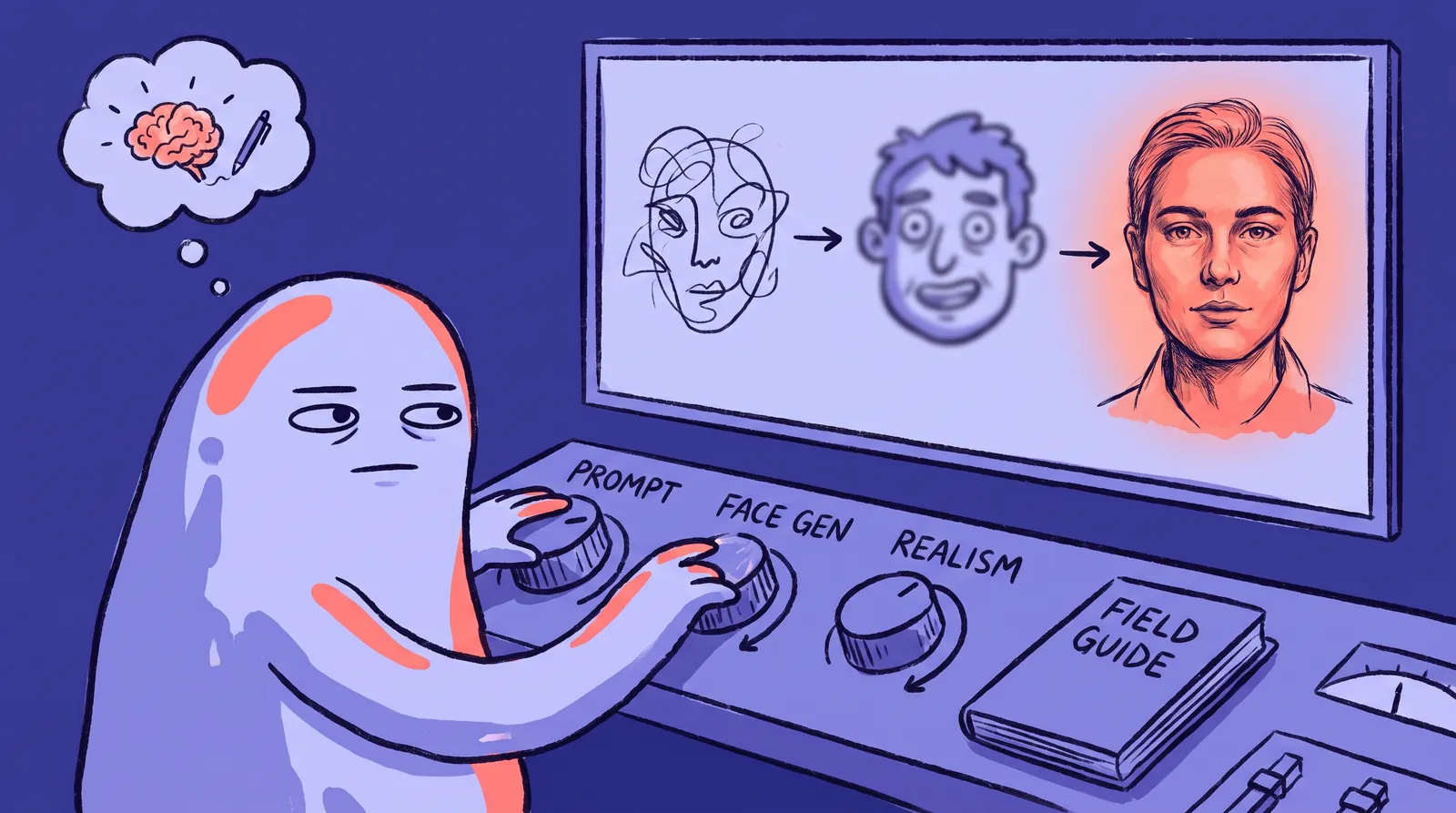
Diffusion models work on a fundamentally different principle. Instead of two networks competing, a single network learns to reverse a noise-adding process. Start with a real image, gradually add random noise until it becomes pure static, then train a model to reverse each step. At generation time, you start with pure noise and the model sculpts it, step by step, into a coherent image. Think of a sculptor removing marble to reveal a figure underneath, guided by a text prompt or reference image.
Three milestones mark the revolution.
- "Denoising Diffusion Probabilistic Models" (Ho et al., 2020) laid the mathematical foundation, showing that this gradual denoising approach could produce high-quality images.
- "Diffusion Models Beat GANs on Image Synthesis" (Dhariwal & Nichol, 2021) was the shot heard round the world. The title said it all. OpenAI researchers demonstrated that diffusion models could surpass state-of-the-art GANs on standard image quality metrics like FID.
- Stable Diffusion (August 2022) democratized everything. Unlike proprietary models, Stability AI released the code and model weights publicly, allowing the model to run on consumer hardware and sparking a massive open-source ecosystem.
The adoption numbers were staggering. Stable Diffusion quickly reached 10 million monthly users after launch. By early 2024, the model had generated an estimated 12 billion images.
Why did diffusion models naturally avoid GAN weaknesses? The iterative denoising process enforces global coherence at every step. There's no mode collapse because the model learns the full data distribution rather than playing a minimax game. Training is stable with standard loss functions. No more hyperparameter roulette.
The early knock against diffusion models was speed. Generating a single image required hundreds of denoising steps, sometimes taking minutes. But innovations like DDIM sampling, latent diffusion (operating in a compressed space rather than pixel space), and distillation techniques compressed generation times from minutes to seconds by 2023 and 2024.
DALL·E 2, Midjourney, and Stable Diffusion captured the public imagination in 2022 and 2023. The infrastructure ecosystem, from cloud providers to fine-tuning tools, consolidated rapidly around diffusion architectures. The tipping point had arrived.
From GAN artifacts to boardroom-ready portraits
The AI headshot market is where this architectural shift played out most visibly.
Early AI headshot tools built on StyleGAN between 2020 and 2022 inherited all the classic artifacts: mismatched earrings, blurred shirt collars, inconsistent lighting between face and background. They were fun novelties. You might share one on Twitter for laughs. But you would never use one for your company's "About Us" page.
The shift in 2023 and 2024 was dramatic. Diffusion-based headshot generators began producing images with coherent clothing, natural backgrounds, consistent lighting, and accurate accessories. They crossed the threshold from "impressive demo" to "professional tool."

The market data backs this up. According to Capturely, HeadshotPro has generated over 17.9 million headshots for more than 196,000 customers, with Fortune 500 companies among its users. Aragon AI claims over 2 million users as of early 2026. These are real businesses serving real professionals, all powered by diffusion.
The numbers on recruiter perception are especially telling. A 2024 Ringover survey of 1,087 recruiters found that 76.5% preferred AI-generated headshots over real ones in a blind comparison. The AI images simply looked more polished. By February 2026, according to Post Everywhere, 89% of recruiters accepted AI headshots as long as they looked professional and authentic.
Why does diffusion excel specifically at headshots? Conditioning mechanisms allow precise control over pose, expression, lighting, and style. The global coherence means every element, from hair to jewelry to collar to background, tells a consistent visual story. No more texture soup.
The economics are compelling too. According to DevOps School, AI headshot tools cost between $25 and $70 for dozens of images, while professional photography sessions average $216 to $427 (with premium sessions exceeding $1,000). Turnaround drops from one to two weeks to under two hours. And a survey cited in late 2025 found that 68% of startups and SMBs already use AI for staff photos.
At Starkie AI, we built on diffusion-based architecture specifically because of these advantages: photorealistic professional headshots with the coherence and controllability that GANs could never reliably deliver.
What GANs still do better (and where they live on in 2026)
It would be dishonest to write GANs off entirely. They haven't disappeared. They've specialized.
Speed remains their advantage. GANs generate images in a single forward pass, producing results in milliseconds. Some benchmarks show a speed difference of more than 1,000x compared to diffusion models, with a GAN taking 0.03 seconds per image versus 40 seconds for a diffusion model. For real-time applications like Snapchat filters, TikTok effects, face animation, and live video editing, that latency gap still matters enormously. Quality compromises are acceptable when you need 30 frames per second.
Latent space editing is the other stronghold. GAN latent spaces are exceptionally well-structured and disentangled, making them powerful for precise semantic editing. Want to age a face by ten years, swap an expression, or change a hairstyle without altering anything else? Many photo editing apps still use GAN-based components under the hood for exactly this.
Hybrid architectures represent perhaps the most interesting development. A finding that surprised many in the research community: GAN-trained components now live inside nearly every modern diffusion pipeline. Every leading diffusion model, from Flux to Stable Diffusion, uses a frozen, GAN-trained autoencoder (VAE) as its backbone. Without that adversarial component, decoded images would be significantly blurrier. GANs didn't die. They became a critical organ inside the systems that replaced them.
But for the specific task of generating high-quality, artifact-free portrait images from scratch, the core use case for AI headshot tools, diffusion models have decisively won. There is no credible path back for GANs in this domain.
What this means for the future of AI-generated portraits
The pace of improvement in diffusion-based portraits is accelerating. Models in 2026 handle complex scenarios that would have been impossible two years ago: reflections in glasses, intricate braided hairstyles, patterned fabrics with consistent weave direction. The detail ceiling keeps rising.

Emerging capabilities are pushing AI headshots beyond static images. Real-time diffusion research is dramatically reducing denoising steps, closing the latency gap with GANs. Video-consistent face generation is improving temporal stability, making AI-generated video portraits more viable. Multi-view synthesis techniques can create consistent 3D head representations from a single 2D input, pointing toward dynamic, interactive professional media.
A word on trust: not everyone is enthusiastic about the shift. The same Ringover survey found that 66% of recruiters would be put off if they knew a headshot was AI-generated, and 88% said its use should be disclosed. Some companies, like Greentarget UK, have formally decided AI headshots are "not appropriate" for company assets after testing them. The technology is advancing faster than professional norms.
For consumers choosing an AI headshot service, understanding this history matters. A tool built on modern diffusion-based architecture, like Starkie AI, produces fundamentally different results than one built on legacy GAN technology. The difference isn't subtle. It's the difference between a clever novelty and a professional tool.
The portrait war is over
The story of GANs in face generation is not a story of failure. It's a story of a brilliant technology that pushed the boundaries of what AI could create, only to be surpassed by an even better approach. StyleGAN showed the world that machines could generate faces indistinguishable from photographs. Diffusion models showed the world that those faces could be coherent, controllable, and truly professional.
For anyone using AI-generated headshots today, on LinkedIn or a company website or a personal brand, that history explains why the current generation of tools produces results that would have looked impossible a few years ago. Every detail, from the earring to the background, now holds together.