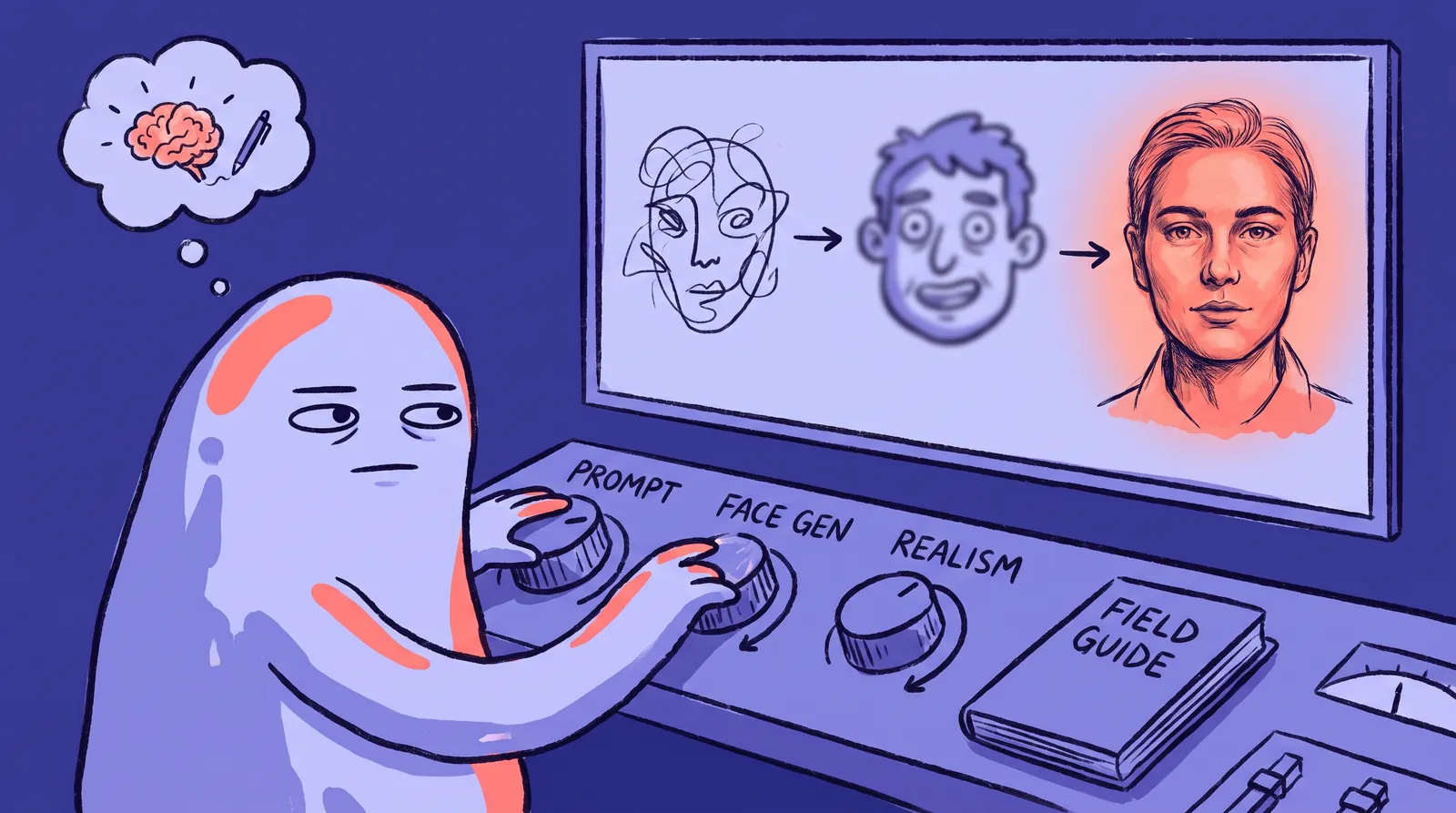
Despite billions of dollars poured into AI image generation, producing a single realistic human face that looks like a specific real person remains one of the hardest unsolved problems in generative AI. Not a generic face. A specific face, with the right age, the right ethnicity, correct symmetry, and professional lighting that doesn't make skin look like melted candle wax.
Here's a scenario that plays out every week in 2026: a marketing manager fires up a leading AI image generator to create headshots for a new team page. The results look impressive at first glance. But zoom in, and something's off. Eyes slightly misaligned. Skin with that telltale waxy sheen. A prompt asking for a 55-year-old executive somehow producing someone who looks 35. The portraits aren't bad, exactly. They're just not right.
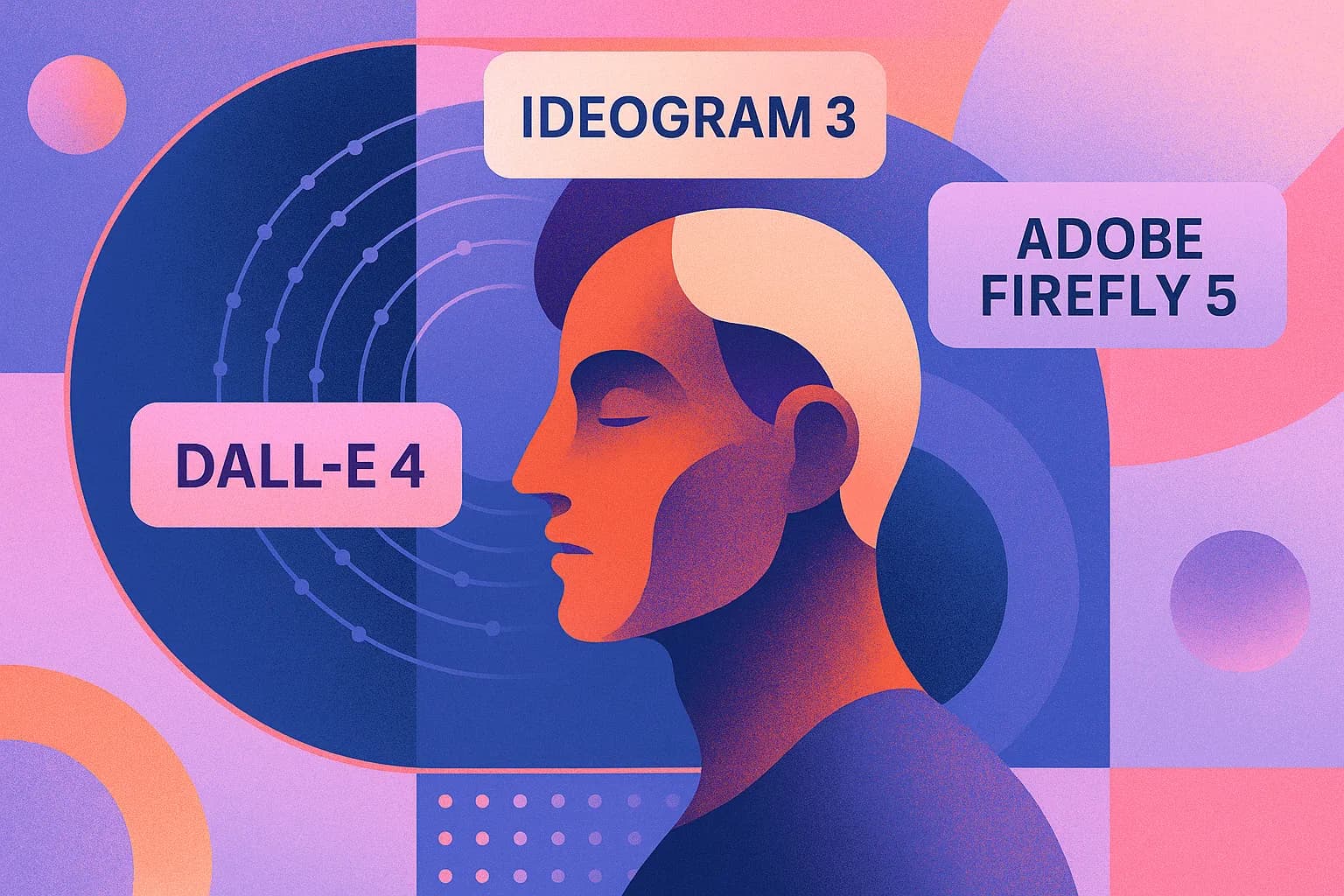
This isn't another best-AI-image-tool roundup. It's a stress test of three leading platforms on the hardest challenge in generative AI: human faces. We tested OpenAI's GPT Image 1.5 (the successor to the DALL-E line), Ideogram 3.0 and Adobe Firefly Image Model 5 against a standardized rubric, with controlled prompts and multiple generations per test. What comes out is a verdict, a reusable scoring framework, and an answer to why even the best general-purpose tools still stumble on faces in ways that matter professionally.
The rubric: How we actually tested these tools on human faces
A fair comparison needs a consistent framework, so each platform was scored out of 10 on five categories.
Facial symmetry and feature accuracy: are the eyes level, are the ears proportional, does the face look anatomically plausible at full resolution?
Skin texture and lighting response: does the skin show realistic pores, undertones and light variation, or does it look airbrushed and flat?
Consistency across generations: run the same prompt five times and do you get five variations of one person, or five different people?
Prompt adherence for specific demographics and age ranges: ask for a 72-year-old with age spots and do you get one?
Professional headshot suitability: would the output pass as a LinkedIn profile photo, and could it run on a corporate website at print resolution?
We used a standardized prompt set across all three platforms. For example: "A professional headshot of a 45-year-old South Asian woman with natural gray streaks, soft studio lighting, neutral background." Every prompt included specific photographic language, because by 2026, including terms like "shot on Canon EOS R5" or "85mm f/1.4" triggers models to replicate specific photographic qualities that dramatically increase facial realism.

A few transparency notes on methodology. These models are stochastic, meaning every generation is different. We ran each prompt a minimum of five times per platform and evaluated the median result, not the best cherry-picked output. Several of these models also auto-enhance vague prompts (Ideogram 3.0's "Magic Prompt" feature, for instance), so our test prompts were deliberately detailed to minimize that variable. And we acknowledge that 2026 research shows humans now perform only marginally better than chance in blind tests distinguishing AI faces from real ones, which means our rubric focuses on subtle, professional-grade differentiators rather than just "does it look real?"
GPT Image 1.5: Stunning scenes, suspicious symmetry
OpenAI retired the DALL-E branding in 2025, folding image generation directly into its multimodal GPT models. The current flagship, GPT Image 1.5, is genuinely impressive in many ways. Prompt comprehension is excellent. Scene-building is rich and contextual. Lighting and background composition are among the best in the industry.
But faces? That's where things get complicated.
GPT Image 1.5 tends to "average" faces toward an idealized, almost airbrushed aesthetic. Neuroscience research from 2026 confirms this pattern: AI-generated faces are unusually symmetrical, well-proportioned, and statistically average, which the human brain initially interprets as attractive but eventually flags as uncanny. When we prompted for "a 60-year-old man with visible laugh lines," the output consistently skewed younger, with skin texture that looked more like a moisturizer ad than a real person.
The consistency problem is severe. Run the same face prompt five times, and you get five different people. There's no persistent identity across generations, which is a critical flaw if you need matching headshots for a team page or brand imagery.
Prompt adherence for demographics showed mixed results. Broad descriptors worked well, but nuanced intersectional prompts caused drift. Asking for "a 38-year-old Nigerian-British woman" risked the model collapsing toward one demographic descriptor over the other rather than synthesizing both.
GPT Image 1.5 scored 8/10 on facial symmetry and feature accuracy, 6.5 on skin texture and lighting response, 5 on consistency across generations, 6 on demographic prompt adherence and 6.5 on professional headshot suitability.
It's best for editorial illustration and concept art, and not yet reliable for professional portrait work.
Ideogram 3.0: The surprise contender for natural portraits
Ideogram built its reputation on industry-leading text rendering. You want legible typography inside an AI-generated image? Ideogram owns that niche. But following its 3.0 release in March 2025 and the surprise open-source launch of Ideogram 4.0 in June 2026, the platform has become increasingly competitive on photorealistic imagery.
Where Ideogram genuinely excels on faces is skin texture. The rendering is noticeably more varied and naturalistic than GPT Image 1.5. Visible pores, realistic undertones, credible under-eye shadows, and actual age markers all showed up in our tests. Early reviews of Ideogram 3.0 noted its images feature more natural lighting, smoother gradients, and better rendering of textures, making portraits feel more grounded in reality.
The lighting gap is the main weakness. Ideogram struggles with complex or directional studio setups. Prompts specifying "Rembrandt lighting" or "single soft-box from the left" produced inconsistent results. Sometimes the shadow fell correctly. Sometimes it didn't exist at all. For professional headshot work, where lighting is half the craft, this inconsistency matters.
Demographic range showed promise. Ideogram's default outputs displayed stronger out-of-the-box diversity than either competitor. But prompt adherence for very specific age ranges (our "72-year-old with age spots" test, for example) still showed regression toward a younger, more generic median face.
Ideogram 3.0 scored 7/10 on facial symmetry and feature accuracy, 8 on skin texture and lighting response, 5.5 on consistency, 7 on demographic prompt adherence and 6 on professional headshot suitability.
It's a genuine dark horse for skin texture and natural portrait aesthetics, with inconsistent lighting control capping its professional ceiling.
Adobe Firefly 5: The enterprise-safe option with real tradeoffs
Adobe Firefly Image Model 5, which entered public beta in October 2025, occupies a unique position. It's the only tool in this comparison built with commercial licensing and enterprise compliance as first-order design constraints. Every output is trained on licensed Adobe Stock imagery, openly licensed content, and public domain material. That shapes everything about its aesthetic.
The results look polished. Professional. Technically correct. And often... slightly generic. Firefly 5's faces carry a persistent "stock photo" quality. They're well-lit, well-composed, and anatomically accurate at native 4MP resolution. But they lack the individuality that makes a headshot feel like it belongs to a real person rather than a template.
Where Firefly genuinely leads is consistency and iterative editing. Adobe's Generative Match feature and its integrated editing suite allow for more controlled iteration on a face than either competitor. You can refine, adjust, and nudge an output toward what you want in ways that feel natural to anyone already in the Adobe ecosystem.
For enterprise use cases, the value proposition is clear. Brands like Deloitte Digital, PepsiCo, IBM, and Mattel use Firefly for scaled content production precisely because of its built-in safety assurances and IP indemnity. If your team needs brand-safe, legally defensible AI imagery, Firefly is the obvious winner. For individuals seeking a believable, personalized headshot, the generic aesthetic is a genuine drawback.
Adobe Firefly 5 scored 8.5/10 on facial symmetry and feature accuracy, 7 on skin texture and lighting response, 7 on consistency, 6 on demographic prompt adherence and 7.5 on professional headshot suitability.
It's the most enterprise-ready tool here, and its safety-first training produces faces that look curated rather than real.
The same prompt, three very different people
Theory is useful. Seeing the actual outputs is better. We ran one richly detailed test prompt across all three platforms:
"Professional headshot, 52-year-old East Asian man, slight five o'clock shadow, warm studio lighting with a soft cream background, business casual attire, direct eye contact, photorealistic."
The results were revealing.
GPT Image 1.5 produced the most technically polished output. Symmetry was near-perfect, background lighting was warm and well-diffused, and the composition felt intentional. But the face looked about 40, not 52. The five o'clock shadow was barely visible. And the skin had that telltale smoothness, more like a retouched magazine cover than a candid professional photo.
Ideogram 3.0 delivered the most naturalistic skin texture. Pores were visible. The five o'clock shadow appeared. Age markers were more appropriate. But the lighting didn't match the prompt. We asked for warm studio lighting with a soft cream background, and got something closer to overcast daylight with a beige wall.
Adobe Firefly 5 split the difference. The face looked age-appropriate, the lighting was close to what we specified, and the composition was clean. But the result screamed "stock photo." It could have been any 50-something man from any corporate website on the planet.

We ran a secondary prompt to check for demographic parity: "Confident professional headshot, 34-year-old Black woman, natural hair, bold red blazer, neutral gray background, sharp focus, DSLR-style." The pattern held across all three tools. GPT Image 1.5 nailed the composition but smoothed the skin. Ideogram got the texture right but fumbled the lighting. Firefly produced something polished but impersonal. Research from late 2025 and early 2026 highlights ongoing disparities in how these tools depict older adults and non-Western features, and our tests confirmed this remains an active issue.
What the case study reveals that rubric scores alone miss: the uncanny valley isn't always about obvious errors. Sometimes a face scores well on every technical metric but still reads as artificial to a human observer. 2026 neuroscience research suggests this happens because we unconsciously detect when facial features mimic appearance but lack the subtle cues of intention and emotional synchronization behind a real expression. The eyes look correct. But they don't look alive.
Why general-purpose AI models still struggle with faces
The explanation is structural rather than mysterious.
General-purpose image models are trained to be good at everything. Landscapes, product mockups, abstract art, architectural renders, food photography, and yes, faces. This breadth means they optimize for average performance across millions of subject types. Faces represent a relatively small slice of that training distribution.
The mismatch is that humans are uniquely, evolutionarily sensitive to facial errors. We evolved to read faces for survival. A landscape with slightly wrong lighting? Most people won't notice. A face with slightly wrong lighting? It triggers an immediate, visceral discomfort response. The uncanny valley effect persists in 2026 precisely because our perceptual hardware for faces is orders of magnitude more sensitive than for any other visual category.
Then there's the identity consistency problem. Generating one convincing face is hard. Generating the same face twice, with different expressions, angles, or lighting, is exponentially harder. General models have no internal concept of "this specific person." Each generation is statistically independent. In direct testing, purpose-built portrait tools managed recognizability in roughly 9 out of 10 generated images, while general-purpose leaders like Midjourney managed about 6 out of 10.
There's also what we call the "prompt tax." Getting a general model to produce a high-quality, specific face requires enormous prompt engineering effort. You need to specify lighting type, camera angle, lens focal length, skin texture descriptors, demographic markers, and more. That knowledge is a barrier for most users, and even experts can't guarantee reproducible results.
Purpose-built portrait tools sidestep many of these limitations by narrowing their scope deliberately. They're trained on portrait-specific datasets, fine-tuned on individual reference photos, and built with face-specific architectures. They trade breadth for depth, and that tradeoff matters enormously for the one thing they're designed to do well.
The verdict table: Who should use what
The summary:
| Category | GPT Image 1.5 | Ideogram 3.0 | Adobe Firefly 5 |
|---|---|---|---|
| Facial Symmetry | 8/10 | 7/10 | 8.5/10 |
| Skin Texture & Lighting | 6.5/10 | 8/10 | 7/10 |
| Consistency | 5/10 | 5.5/10 | 7/10 |
| Demographic Adherence | 6/10 | 7/10 | 6/10 |
| Headshot Suitability | 6.5/10 | 6/10 | 7.5/10 |
| Composite | 6.4/10 | 6.7/10 | 7.2/10 |
| Best For | Editorial & concept art | Natural aesthetics on a budget | Enterprise brand compliance |
For creative directors doing editorial work, GPT Image 1.5 gives the richest scene-building and compositional control, as long as you don't need faces that look like specific real people. For independent creators and marketers on a budget, Ideogram 3.0, or the newly open-source 4.0, gives the most naturalistic skin texture and the best value, particularly with text overlays. And for enterprise marketing teams with compliance requirements, Adobe Firefly 5 remains the default on commercial-safe licensing and IP indemnity.
None of the three, at their best, consistently produces professional headshots that survive professional scrutiny without manual retouching. That gap costs real time and money. A designer spending 30 to 45 minutes in Photoshop fixing each AI-generated headshot quickly erases the efficiency gains that justified using AI in the first place.

If the best general-purpose AI tools in 2026 still fall short for professional portrait needs, the right tool for that job may not be a general-purpose tool at all.
The right tool for the right job
The three most powerful general-purpose AI image generators available in 2026 are genuinely impressive. And genuinely limited when it comes to human faces. The failures aren't bugs waiting for a patch. They reflect structural tradeoffs in how these models are designed, trained, and optimized for breadth over depth.
A tool that does everything well rarely does any one thing excellently, and faces demand excellence. The gap between general-purpose image tools and purpose-built AI portrait tools isn't closing as fast as the hype suggests.
For professionals, marketers, and individuals who need a headshot that actually looks like them, at a specific age, with a specific expression, in a specific style, the most honest advice is to use a tool built for exactly that job.
That's what Starkie AI is for. It's trained on portrait data specifically and built around the consistency, realism and demographic accuracy problems this comparison exposes. It doesn't generate landscapes or product mockups, only faces.
Try a free generation and compare the result against anything above.