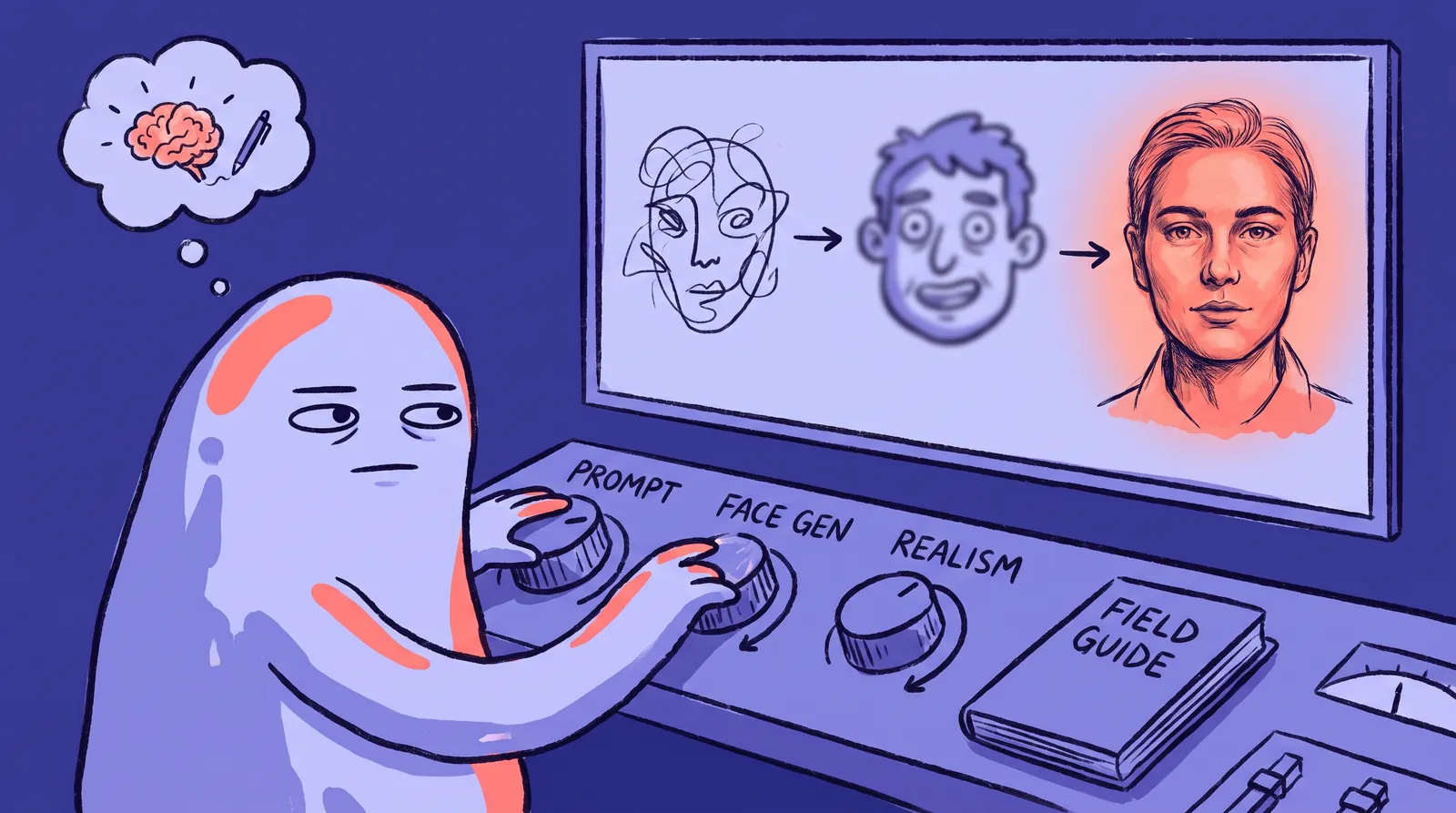
Remember the horror teeth? Those nightmarish grins with too many incisors, the melting ears, the hands with seven fingers, and the glass-eyed stares that screamed "a computer made this"? Early AI image generators turned human faces into something between a wax museum reject and a fever dream. We've come a long way.
DALL-E 4, OpenAI's latest image model, released in early 2026, scores above 90% on human realism benchmarks for frontal portraits. That's a large leap from DALL-E 2's waxy skin and DALL-E 3's uncanny smoothness. The question worth asking is whether "mostly convincing" is the same thing as "useful."
The gap between an impressive demo and a LinkedIn-ready headshot is wider than the marketing suggests. What follows is what DALL-E 4 gets right, what it still gets wrong, and where purpose-built tools still hold an edge.
Why faces are the final boss of AI image generation
Your brain is wired to detect fake faces. Literally.
The fusiform face area (FFA) and occipital face area (OFA) are specialized brain regions dedicated entirely to face detection and processing. A healthy FFA integrates facial features into a single perceptual unit in under a second, producing a neural signature known as N170. This means you don't look at a face the way you look at a chair or a landscape. You process it holistically, and you catch deviations in milliseconds.
This is why the uncanny valley hits hardest with faces. Research shows that "uncanny" images activate these same facial processing regions, triggering a specific neural response of unease in the prefrontal cortex, the part of your brain responsible for value judgments. A slightly wrong eye alignment or an oddly smooth patch of skin doesn't just look "off." It feels wrong on a neurological level.

The history of AI face generation is a museum of these failures. DALL-E 2 produced waxy skin and asymmetric pupils. Midjourney v5, while aesthetically polished, drew criticism for its "too perfect," painterly smoothness that lacked photorealistic texture. Early versions of Stable Diffusion were notorious for generating nightmarish quantities of teeth and erratic ear geometry.
The technical reasons run deep. Diffusion models historically lacked explicit 3D understanding of facial geometry. Token attention would diffuse across fine features like eyelashes and pores, blurring them together. And CLIP's semantic anchoring of facial landmarks was loose enough that "crow's feet" and "laugh lines" often got averaged into generic wrinkle patterns.
This matters well beyond aesthetics. Professional headshots, ID-style photos, marketing materials, and LinkedIn profiles demand a level of realism that separates general models from purpose-built tools. A face that's 90% convincing in a thumbnail might fall apart at full resolution, and that last 10% is exactly where professional credibility lives.
With that context set, here's what OpenAI actually changed under the hood, and why some of it is genuinely impressive.
What OpenAI changed in DALL-E 4: The architecture behind the faces
The biggest shift in DALL-E 4 isn't any single feature. It's architectural. OpenAI moved from a pipeline of separate text and image models (the old DALL-E 3/CLIP arrangement) to a natively multimodal architecture. The model processes text and visual inputs together in a single neural network, which changes how it "understands" facial descriptions.
CLIP alignment improved first. DALL-E 4 uses a next-generation CLIP variant with finer-grained semantic grounding. In practical terms, when you write "crow's feet" in a prompt, the model no longer averages that into a generic wrinkle pattern. It grounds the descriptor in a functionally accurate arrangement: the specific radiating lines at the outer corners of the eyes, the nasal folds, the way laugh lines interact with cheek muscle structure. The difference between DALL-E 3's interpretation and DALL-E 4's is the difference between "has some wrinkles" and "looks like a person who has smiled a lot for 45 years."
Inpainting coherence came next. Inpainting is the process of filling in or correcting regions of an image. In older models, eyes, ears, and pupils were generated as somewhat disconnected parts. DALL-E 4's unified architecture means the model maintains a coherent understanding of the entire face simultaneously during inpainting. If you fix one eye, the correction respects the geometry of the other eye, the bridge of the nose, and the overall facial symmetry. Early reviews noted the model is "leagues ahead" in text-based inpainting adherence.
The latent space also runs at a higher internal resolution during the diffusion process. This captures pores, stubble, and fine wrinkles that previously blurred into plastic-looking skin. The result is texture that reads as skin rather than smoothed silicone.

And OpenAI reportedly used reinforcement learning from human feedback (RLHF) specifically focused on face outputs. Human raters evaluated face quality on dimensions like symmetry, skin realism, and expression naturalness. This differs from general RLHF, which optimizes for broad output quality. Targeted face RLHF directly closes the uncanny valley gap by teaching the model which specific facial artifacts humans find most disturbing.
Prompt vs. reality: Where DALL-E 4 shines and where it still stumbles
Start with what works.
A prompt like "A 45-year-old South Asian woman with natural laugh lines, minimal makeup, and a confident, genuine expression" now produces results with notable realism. Consistent eye contact, accurate skin texture, proportional facial features, and expressions that read as genuine rather than vacant. This is a significant improvement over DALL-E 3's tendency to default to generic, slightly plastic faces.
Profile and three-quarter angles improved meaningfully too, and they were historically a disaster zone. DALL-E 4 shows marked improvement in ear geometry, nose bridge continuity, and jaw definition at non-frontal angles. It's not perfect, though. Some users have noted that the model still struggles with precise details like specific beard growth patterns at non-standard angles, defaulting to more generic textures.
Now the failures.
Complex lighting still causes problems. Strong side-lit shadows create skin tone inconsistencies on one side of the face. The model handles soft, even lighting beautifully but struggles when shadows need to interact realistically with facial contours.
Teeth remain tricky. Requests for "natural smile with teeth showing" occasionally regress into the classic uncanny grin. The model has improved dramatically from the horror teeth era, but it hasn't fully solved the challenge of rendering individual teeth with realistic spacing, translucency, and gum lines.
Elderly faces trend toward caricature. Very old faces with deep wrinkles often get idealized or smoothed. The model produces what looks like a heavily retouched portrait rather than truly aged skin with its irregular folds and mottled texture.
Prompt sensitivity is a genuine usability problem. "Professional headshot of a man" and "studio portrait of a man in his 40s" produce visibly different quality. Small wording changes produce dramatically different results, which means non-expert users face a frustrating trial-and-error loop.
The diversity test: Skin tones, age, and representation
This matters more than the technical specs.
DALL-E 4 shows genuine improvement in skin tone rendering across the Fitzpatrick scale. Deeper skin tones no longer default to over-saturated or under-lit results as frequently. This is a meaningful step forward from DALL-E 3's well-documented demographic bias, which showed a preference for "young, white, beautiful people" in generic prompts. Multiple studies from 2024 and 2025 confirmed significant bias in both DALL-E 3 and Midjourney, with lighter skin tones severely overrepresented, sometimes appearing in over 90% of outputs for generic prompts.
Age representation follows a predictable gradient. Young adult faces are most reliable. Middle-aged faces are good but can skew younger. Elderly faces (70+) often produce slightly smoothed, idealized results rather than truly aged skin.
On gender and feature diversity, DALL-E 4 is less prone to defaulting to hyper-feminine or hyper-masculine archetypes when gender-neutral prompts are used. That's a meaningful improvement for inclusive applications.
But bias hasn't been eliminated. Prompts without explicit ethnicity descriptors still skew toward ambiguously Western European features in many outputs. If you're using this tool for corporate team pages or marketing materials, that inconsistency isn't just a technical limitation. It's a business credibility issue. A tool used for LinkedIn photos or team headshots must perform equitably across all employees.
Case study: Using DALL-E 4 to generate a professional headshot
A freelance designer wants a LinkedIn headshot without hiring a photographer, and turns to DALL-E 4.
The naive prompt first: "Professional headshot of a graphic designer." The result is technically competent: correct proportions, reasonable eye color, acceptable composition. But it has that distinct "typical AI look," with smooth, plastic-like skin, an oddly compressed background, and an expression that reads as vacant rather than confident. It's recognizably artificial.
Adding specificity helps significantly. "Natural soft light from the left, shallow depth of field, subtle confident smile, sharp focus on realistic skin pores, dark blue blazer, warm neutral background, cinematic grain." The realism improves noticeably. Skin texture appears, the expression gains life, and the lighting feels more natural. But getting here required prompt engineering knowledge that most users simply don't have.

That second output has a slightly misaligned left eye. DALL-E 4's improved inpainting can correct this, and the fix respects the surrounding facial geometry. But the iterative workflow is time-consuming. Select the region, describe the correction, evaluate the result, repeat if needed. It requires technical comfort and patience.
DALL-E 4 can produce headshot-adjacent results with effort. The process is iterative, inconsistent and dependent on expertise, none of which scales for a busy professional or a growing team.
DALL-E 4 vs. specialist portrait tools: The right tool for the right job
This isn't a competition so much as a question of purpose.
DALL-E 4 is a general-purpose model. Tools like Starkie AI are purpose-built for professional headshots. They solve different problems, and they excel in different areas.
DALL-E 4 wins on creative flexibility. You can generate cyberpunk-styled portraits, oil painting interpretations, concept art characters, and experimental imagery that no specialist tool can match. For ideation, mood-boarding, and character design, general models are unrivaled.
Specialist tools win on consistency, identity preservation and ease of use. DALL-E 4 generates a different face every time from the same prompt. It produces highly polished faces that simply don't look like you. Specialist headshot tools train on your actual photos (typically 10 to 20 selfies) to create an AI model of your face. They maintain your identity across outputs, often with enough fidelity to pass facial recognition checks.
The consistency gap is the biggest practical differentiator. If you need one creative portrait for a blog post, DALL-E 4 might work. If you need a set of professional headshots that actually look like you, with consistent lighting and backgrounds suitable for a corporate team page, you need a specialist tool.
The workflow difference matters too. DALL-E 4 requires iteration: prompt, evaluate, refine, inpaint, repeat. Purpose-built tools like Starkie AI offer a streamlined process that non-technical users can complete in minutes. Upload your photos, choose your style, and receive polished results without writing a single prompt.
What DALL-E 4's progress tells us about the future
The trend line is clear. Each major model release closes the uncanny valley gap meaningfully. Photorealistic generation of arbitrary faces (not specific people) is expected to be effectively solved within one to two more model generations.
As general models improve, though, the bar for professional quality rises with them. Specialist tools will need to stay ahead by offering capabilities that general models structurally can't provide. Identity consistency across sessions. Brand-specific styling for enterprise clients. Legal certainty that generated assets don't resemble trademarked property. Privacy compliance with standards like SOC 2 Type II.
The most sophisticated users in 2026 are already building hybrid workflows. They use general models like DALL-E 4 for ideation and creative exploration, then turn to specialist tools for final, polished output. That's a smart approach, and it's worth embracing.
One last point. As face generation gets more convincing, labeling AI-generated imagery clearly matters more, not less. That holds whether you use DALL-E 4, Starkie AI or anything else.
Impressive, still not reliable
We've come a long way from horror teeth and melting ears. DALL-E 4 is a genuine leap forward. Its improved CLIP alignment, inpainting coherence, higher-resolution latent space, and better diversity of representation make it the most capable general-purpose face generator available in 2026.
But "most capable general-purpose" is still a long way from "reliably professional." The case study makes this concrete: getting a polished, consistent headshot from DALL-E 4 takes iteration, expertise, and luck. Three things that don't scale.
If DALL-E 4's capabilities have you curious about what a purpose-built tool delivers in a fraction of the time, Starkie AI is built around exactly that: portrait quality, identity preservation and not needing to write prompts.